Atlanta Poolhouse Jova Daniels Busby Archive: The 1968 Poolside Pavilion That Still Feels Smart
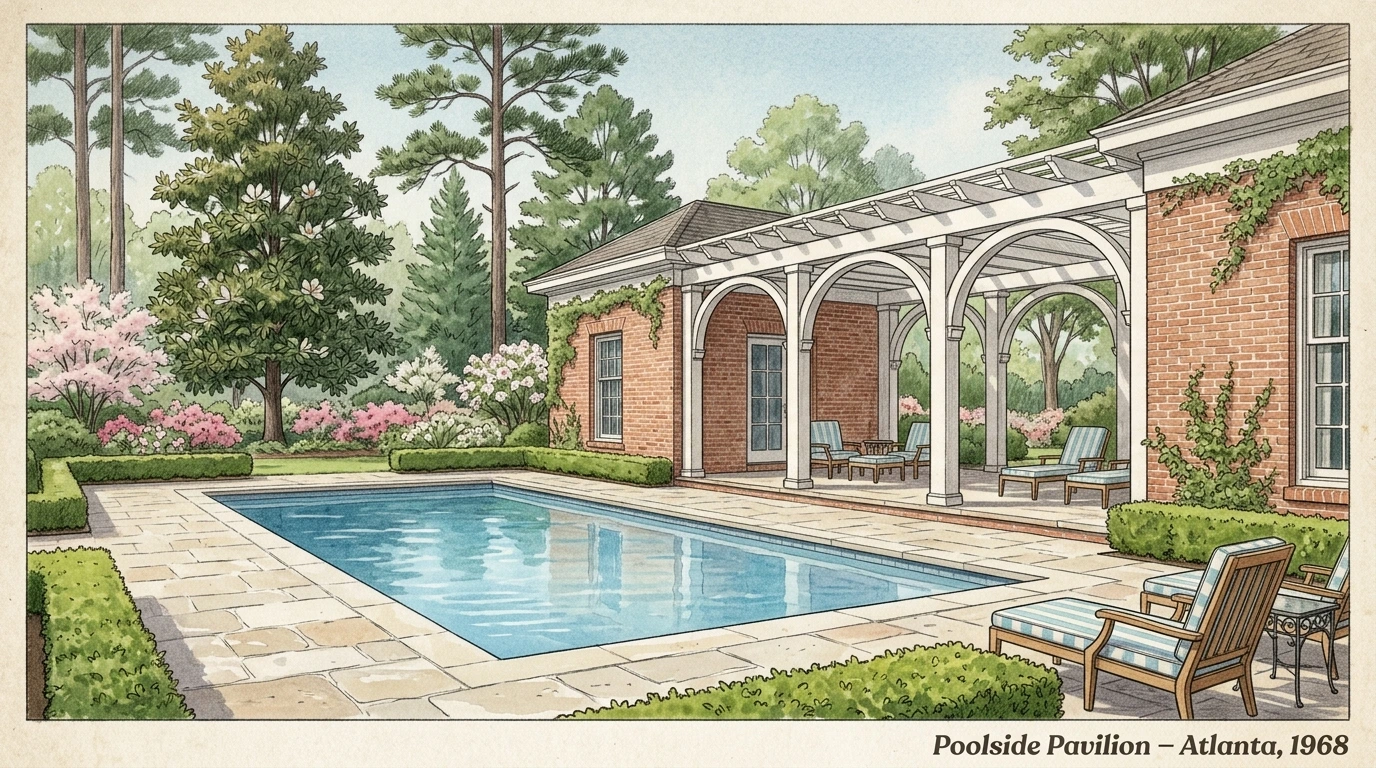
The Atlanta poolhouse Jova Daniels Busby archive points to a rare kind of design story: a private backyard structure that still feels worth studying decades later. The poolside pavilion, featured in House Beautiful’s July 1968 issue, was built for the Atlanta home of Mr. and Mrs. Robert Chambers and designed by the architecture firm Jova, Daniels, and Busby. It was not just a pretty shelter beside a pool. It combined shade, entertaining, storage, changing rooms, color, garden setting, and architectural character in one compact building.
What makes the project interesting today is not nostalgia alone. It shows how outdoor rooms can work when they are planned with the same care as a main house. The Atlanta poolhouse Jova Daniels Busby archive gives modern homeowners, designers, and architecture fans a clear example of how a small structure can carry style, function, and memory without feeling overbuilt.
Why the Atlanta Poolhouse Jova Daniels Busby Archive Still Matters
The Atlanta poolhouse Jova Daniels Busby archive matters because it captures a point when American outdoor living was becoming more intentional. A poolhouse was no longer only a place to store towels or hide equipment. In this project, it became a setting for guests, a shaded garden room, a changing area, and a visual anchor at the edge of the water.
The pavilion also matters because of the people behind it. Henri Jova, Stanley Daniels, and John Busby founded Jova/Daniels/Busby in 1966, and the firm later became known for architecture, planning, and interior design work across commercial, institutional, public, educational, health care, and research projects. Georgia Tech’s archival record describes the firm’s visual materials collection as drawings, sketches, and renderings from about 1966 to 2000, while noting that not every project is represented in the collection.
The Known Story Behind the 1968 Atlanta Poolside Pavilion
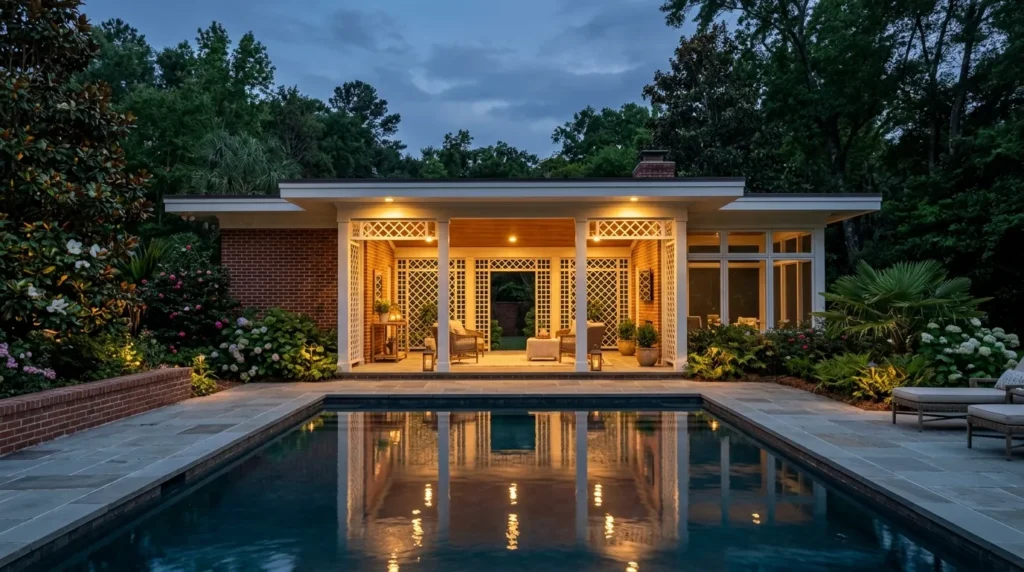
The best-known published record of the pavilion comes from a House Beautiful archive feature tied to the magazine’s July 1968 issue. The original story presented the structure as a poolside pavilion in a garden at the Atlanta home of Mr. and Mrs. Robert Chambers. The design brief was practical but elegant: create an open loggia for poolside entertaining, two dressing rooms with baths, and storage for pool equipment and outdoor furniture.
That is the strength of the archive. It gives enough detail to understand the project without pretending to answer every private-house question. We know the building sat beside a pool, worked as an entertainment pavilion, and used design language connected to the main house. We also know the exterior used common brick and a wood trellis painted white, while the interior used tile, vaulted forms, and a cool color palette tied to the water.
For readers planning the area around a poolhouse, our guide to backyard hardscaping ideas can help connect paving, planting, and seating into one layout.
Who Were Jova, Daniels, and Busby?
To understand the Atlanta poolhouse Jova Daniels Busby archive, it helps to understand the firm. Jova/Daniels/Busby was founded in 1966 by Henri Jova, Stanley Daniels, and John A. Busby Jr. The firm provided architecture, planning, and interior design services and became closely associated with Atlanta’s postwar growth. Georgia Tech’s finding aid says the firm helped plan and design Colony Square, described there as the first mixed-use development in the Southeast.
Henri Jova’s background adds more context. The American Academy in Rome records that Jova was a 1951 Fellow, moved to Atlanta in the 1950s, and later became a founding partner of Jova/Daniels/Busby. It also describes his work as a fusion of modernism and classical design, especially in residential projects. That phrase fits the pavilion well. The poolhouse is not pure modernism, and it is not a historical copy. It borrows from older design languages, then turns them into a relaxed garden structure.
What the Archive Tells Us About the Design
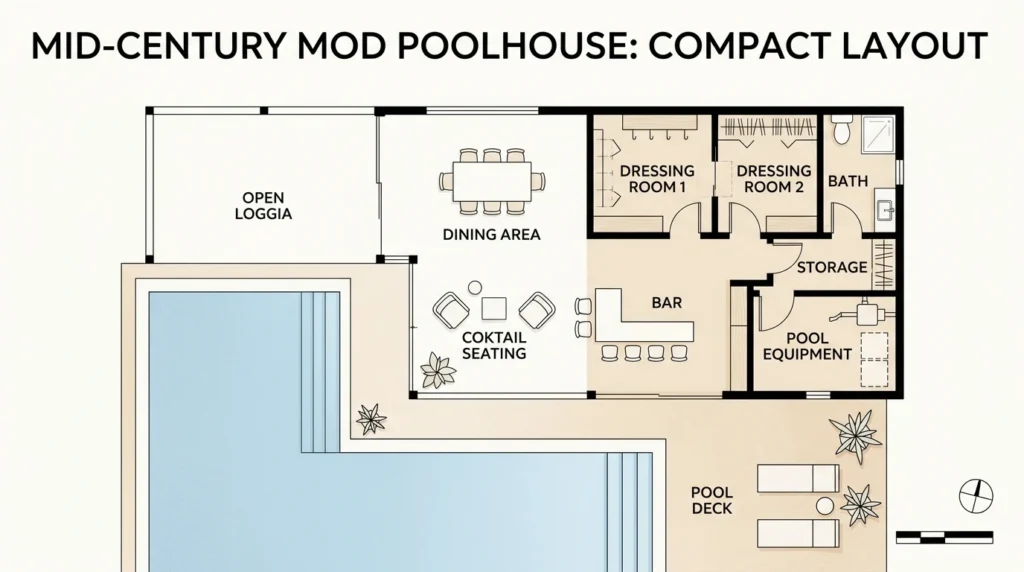
The Atlanta poolhouse Jova Daniels Busby archive reveals a design built around clear zones. At the front was the open loggia. Behind it were twin dressing rooms and baths. Between daily convenience and social pleasure sat a bar and built-in music system. The plan suggests that guests could arrive, change, swim, sit, eat, drink, listen to music, and leave without constantly moving through the main house.
That layout is still useful. Many modern outdoor rooms fail because they look good in a photo but ignore how people actually move. This pavilion starts with behavior. It separates wet and dry activities. It keeps storage out of view. It gives guests privacy. It places the social space where it can face the pool and garden. The result is a building that feels charming but works because the plan is disciplined.
A Poolhouse Designed as a True Outdoor Room
The open loggia was the heart of the design. It was not a narrow porch or decorative afterthought. It was large enough to support different uses, including cocktails on one side and outdoor dining on the other. That split shows a strong understanding of entertaining. People do not use a party space in one fixed way. They sit, stand, talk, eat, and drift between smaller groups.
The Atlanta poolhouse Jova Daniels Busby archive also shows the value of shelter without full enclosure. The pavilion provided shade and architectural definition while staying connected to the pool. In a warm Southern garden, that balance matters. Too much enclosure can make a poolhouse feel heavy. Too little shelter makes it useless during heat or light rain. This design sits between those extremes.
Small-space readers can also review the best small patio design ideas for compact seating zones that work beside pools and gardens.
Dressing Rooms That Solve a Real Problem
The twin dressing rooms may look like a luxury detail, but they solve a practical issue. Pool guests need somewhere to change, dry off, use a bathroom, and handle personal items. Without that space, the main house becomes part hallway, part locker room. The Chambers pavilion kept those activities close to the pool and away from the primary interiors.
This is one reason the Atlanta poolhouse Jova Daniels Busby archive feels current. Many homeowners still underestimate support spaces. They spend money on the visible outdoor lounge, then forget towel storage, wet-floor transitions, restroom access, changing space, and equipment. Jova, Daniels, and Busby did the opposite. They made the support functions part of the architectural idea.
Style: Regency, Chinese Chippendale, and Atlanta Garden Life
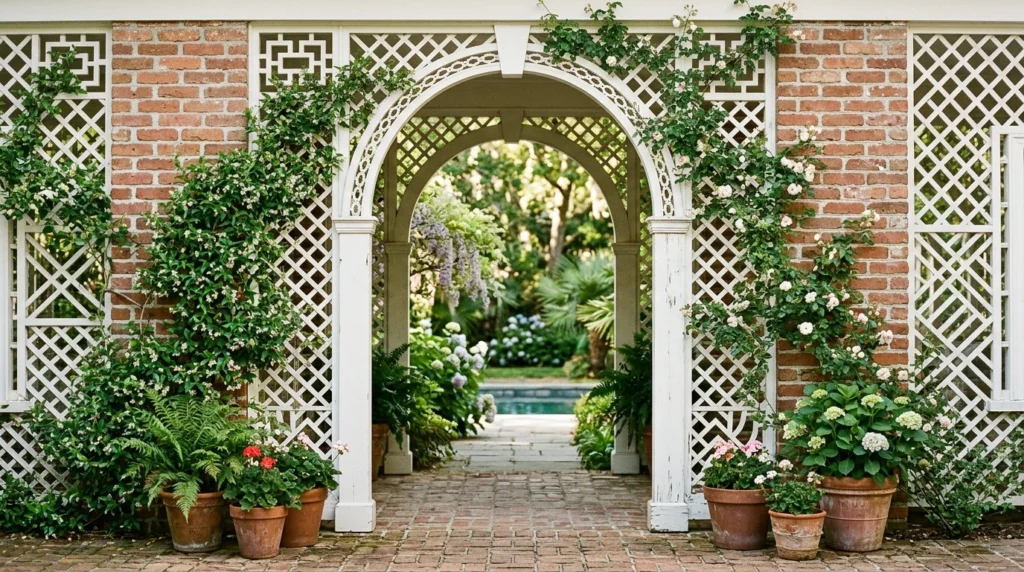
House Beautiful’s archive says the architects drew from Regency and Chinese Chippendale flavor in relation to the main house. That matters because the poolhouse was not treated as an isolated object. It belonged to a larger domestic composition. The white trellis, arched openings, latticework, and garden placement created a structure with a light, ornamental character.
The danger with decorative references is that they can become costume. Here, the design works because the references are filtered through use. The trellis provides visual rhythm and partial enclosure. The white finish helps the building feel cool beside the pool. The arches frame views. The light roof color and garden setting soften the structure. The Atlanta poolhouse Jova Daniels Busby archive is valuable because it shows ornament being used with restraint.
For flexible outdoor styling, 7 new ikea essentials for a multi use outdoor setup show how modular pieces can support dining, lounging, and storage.
Why the White Trellis Works
The white trellis can look delicate, but in this project, it does real visual work. It breaks down the mass of the pavilion, catches light, and gives the garden elevation a sense of pattern. Around a pool, where surfaces can feel flat and hard, that pattern adds texture. It also makes the building look more open than a solid wall would.
The archive also shows how material contrast can shape mood. Bricks give the structure weight. The wood trellis gives it air. Tile gives the interior a cool surface. Planting gives the scene softness. None of these elements carries the full design alone. The pleasure comes from how they support each other.
The Color Palette: Blue, Lime Green, and Pool Reflections
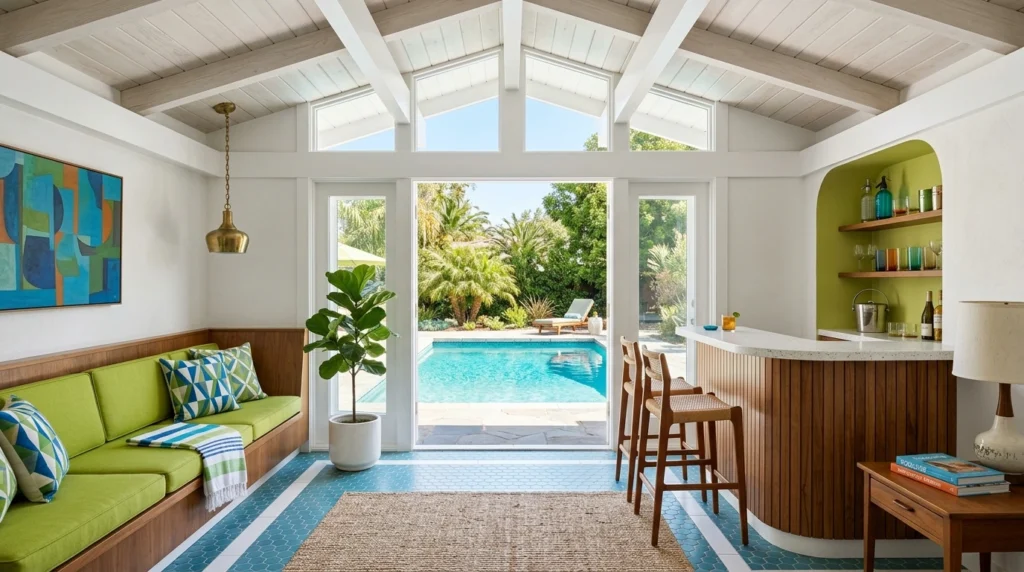
The interior is one of the project’s strongest details. The archive describes a tiled and vaulted interior with lime green and blue tones that relate to the pool. That decision matters because it makes the inside feel like part of the water setting. The colors are not random decoration. They extend the pool atmosphere into the shelter.
This is a lesson many outdoor spaces miss. A poolhouse should not feel like a detached guest room unless that is the purpose. It should respond to water, light, wet feet, garden views, and heat. In the pavilion archive, the color story supports that experience. It makes the pavilion feel cool before anyone touches the water.
The Floor Plan: Small Building, Big Intent
The floor plan is one of the most useful parts of the archive. It shows a rectangular structure organized with the loggia toward the pool and the private rooms at the rear. A bar and stereo sit near the center, where service and social activity meet. The design does not waste space on grand gestures that fight the purpose of the building.
The Atlanta poolhouse Jova Daniels Busby archive is not impressive because of its size. It is impressive because of the hierarchy. Public space faces the view. Private space stays behind. Utility sits where it can serve both. The pool edge becomes an outdoor threshold, not just a strip of paving.
Circulation Was the Hidden Luxury
Luxury in this pavilion is not only in the color, trellis, or magazine styling. It is in the ease of movement. Guests could move from pool to loggia, from loggia to dressing room, and from seating to dining without confusion. Good circulation often disappears because it feels natural. Bad circulation is noticed every minute.
That is why the archive deserves a close reading. It shows that outdoor comfort depends on planning before decoration. A chair can be replaced. A tile color can be changed. But if the building ignores guest flow, wet zones, storage, privacy, and shade, the space will always feel awkward.
How the Pavilion Fits Atlanta’s Design History
The pavilion is a small residential project, but it belongs to a larger Atlanta story. Jova/Daniels/Busby formed during a period when the city was reshaping its urban identity. Their major public and commercial work, including Colony Square, placed the firm inside Atlanta’s conversation about mixed-use living, Midtown revitalization, and modern design.
SAH Archipedia describes Colony Square as an early mixed-use urban design combining office, retail, and housing. It notes that the basic layout is credited to landscape architect Paul Friedberg, while the architecture was the first major work of the newly formed partnership Jova/Daniels/Busby. The same source describes the project’s New Formalist and Brutalist qualities, which show the firm could work at a completely different scale from a delicate poolside pavilion.
This residential pavilion is important because it shows another side of that practice. Instead of concrete towers and urban passages, we see a garden structure. Instead of a district, we see a pool edge. Yet the same discipline appears: movement, setting, form, and use are all connected.
What Modern Homeowners Can Learn From the Archive
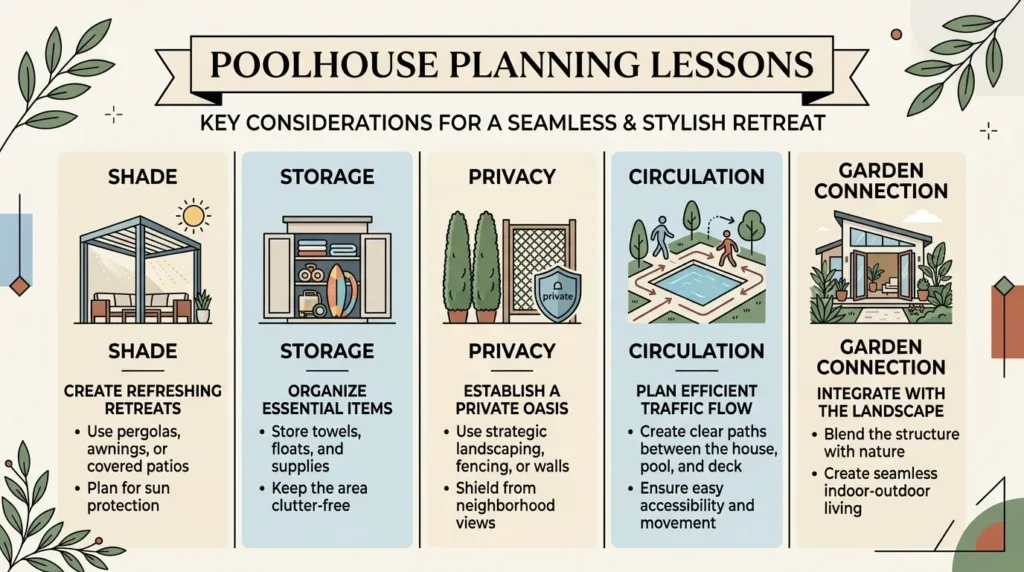
The first lesson is simple: plan the boring parts early. The best poolhouse is not only a photogenic backdrop. It handles towels, storage, water, guests, equipment, bathrooms, shade, lighting, and movement. The Chambers pavilion did those things with grace because the utility was not treated as a leftover.
The second lesson is to let the main house guide the accessory structure. The archive notes that the architects borrowed from the main house. That does not mean every detail had to match. It means the poolhouse had a visual relationship with its setting. A modern version might use brick, roof pitch, window rhythm, trim color, or landscape geometry to create that connection.
The third lesson is to design for day and night. The archive notes the pavilion’s evening presence, with light reflecting near the water. Good poolside design changes after sunset. Lighting should help people move safely, but it should also give the garden a calm mood. This is where a small structure can become the emotional center of an outdoor space.
What Designers Should Not Copy Blindly
The archive is useful, but copying it without context would be a mistake. The pavilion belonged to a specific home, garden, client brief, and era. A white trellis pavilion may not suit every house. A blue roof may not suit every landscape. Separate dressing rooms may be unnecessary for a small family pool.
The smarter approach is to copy the logic, not the surface. Keep the shade. Keep the clear plan. Keep the link between architecture and garden. Keep the support functions close to the pool. Keep the color palette connected to water and planting. Change the style when the site demands it. That is how archival design becomes useful instead of nostalgic.
Adapting the Idea for Today
A present-day version could include a compact restroom, towel storage, a covered lounge, a small serving counter, and discreet equipment access. It could also use more durable materials, energy-efficient lighting, and safer wet-area surfaces. The point is not to recreate 1968 exactly. The point is to keep the human comfort that made the original work.
The archive also reminds us that outdoor living does not have to be oversized. Many homes would benefit from a smaller, better-planned structure instead of a large, vague patio zone. A modest pavilion with shade, storage, seating, and one strong view can feel richer than a bigger space with no order.
Why This Archive Feels Fresh in Modern Outdoor Design
Outdoor living has changed, but the basic needs remain the same. People still want shade, beauty, comfort, water access, privacy, and a place to gather. The difference is that many modern projects chase features first: outdoor kitchens, screens, fire bowls, speakers, bars, and oversized furniture. Features can help, but only when the layout is sound.
The Atlanta poolhouse Jova Daniels Busby archive feels fresh because it starts with architecture. It creates a room, not just a product display. The trellis gives enclosure. The loggia gives purpose. The dressing rooms give function. The tile gives atmosphere. The garden gives softness. The pool gives reflection and movement. That full composition is why the pavilion is still worth discussing.
Preservation, Archives, and What We Still Do Not Know
A responsible reading of the archive should also admit its limits. Publicly available records confirm the magazine feature, the design team, the client name, the main functions, and many design details. They do not fully answer later changes to the property, the current condition of the pavilion, or every construction specification. Georgia Tech’s archive also states that its Jova/Daniels/Busby collection does not include material from all projects and that even represented projects may not have complete drawing sets.
That uncertainty does not weaken the archive. It makes the archive more valuable. It reminds readers that design history is often built from surviving fragments: magazine spreads, floor plans, photographs, finding aids, and institutional records. Each piece adds context, but no single piece tells everything.
Conclusion: A Small Pavilion With a Long Design Life
The archive is more than a vintage poolside feature. It is a compact lesson in how outdoor architecture can serve people well. The pavilion gave guests shade, comfort, privacy, storage, color, and a strong garden setting. It used historic references without becoming stiff. It supported entertaining without ignoring practical needs.
Its value today is clear. Homeowners can learn from its planning. Designers can learn from its restraint. Architecture fans can see how Jova, Daniels, and Busby moved between city-scale ambition and residential detail. The pavilion still feels alive because its best ideas are not trapped in 1968. They are basic, durable principles: respect the site, plan the movement, hide the clutter, shape the shade, and let the building belong to the garden.