10 Craft Room Office Ideas That Blend Work and Creativity Beautifully
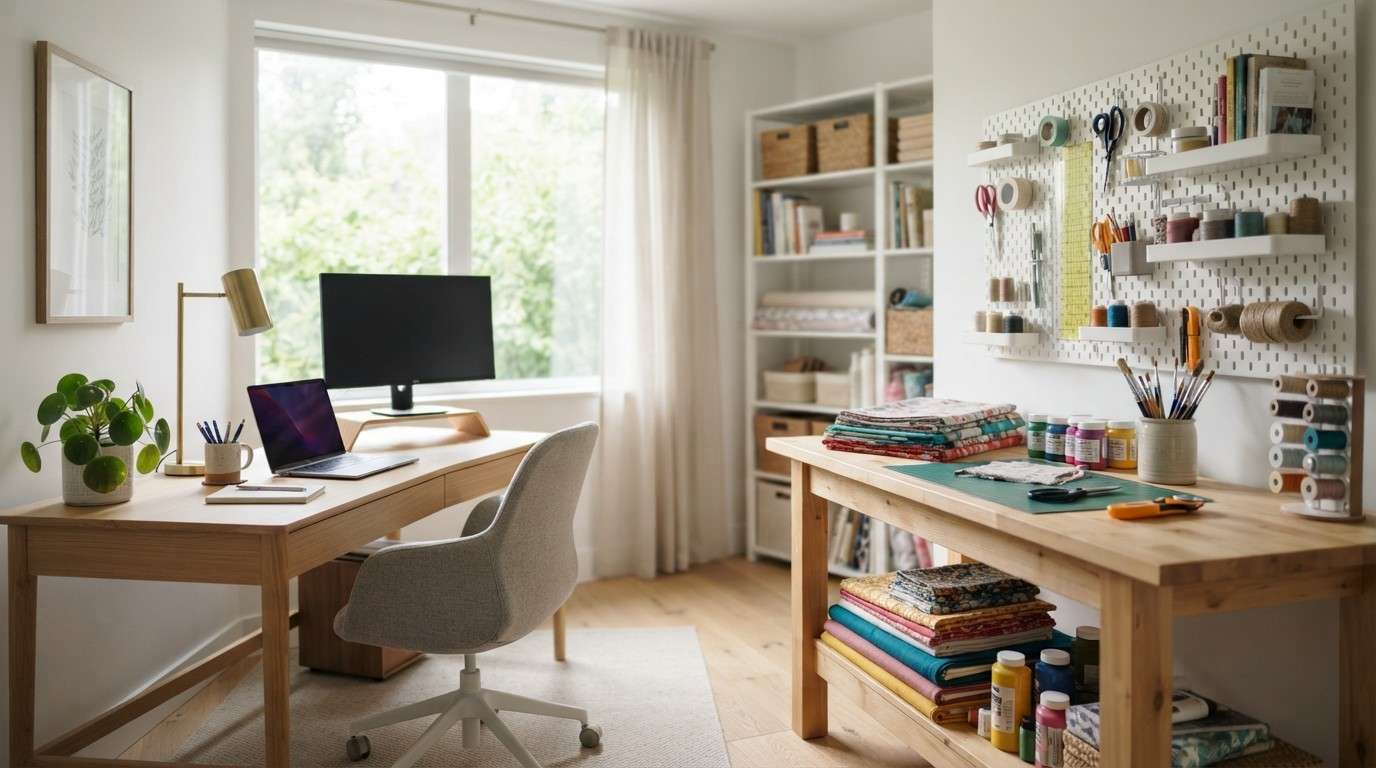
Somewhere between the laptop and the glue gun, a lot of homes have quietly run out of rooms. Remote work stuck around, hobbies got serious, and suddenly one spare bedroom needs to hold a monitor, a sewing machine, and a stack of unfinished scrapbook pages all at once. A well-planned craft room office solves that problem without forcing you to choose between productivity and creativity.
This guide skips the generic mood boards. Instead, it walks through how to actually plan the layout, which design styles hold up under real daily use, what a realistic budget looks like, and a few practical details—like tax rules and safety—that most decorating articles never mention.
What Is a Craft Room Office Combo, and Why Are So Many People Building One?
It’s exactly what it sounds like: one room designed to handle focused desk work and hands-on crafting without either activity taking over. It typically pairs a computer desk or laptop station with a dedicated crafting surface, plus storage for both office supplies and hobby materials.
The appeal is practical rather than trendy. Spare bedrooms are shrinking in new construction, and many households already juggle a side business, freelance work, or a resale shop alongside sewing, painting, or paper crafting. Combining the two spaces means one room earns its keep instead of sitting half-used.
Plan Before You Decorate: The Layout Comes First
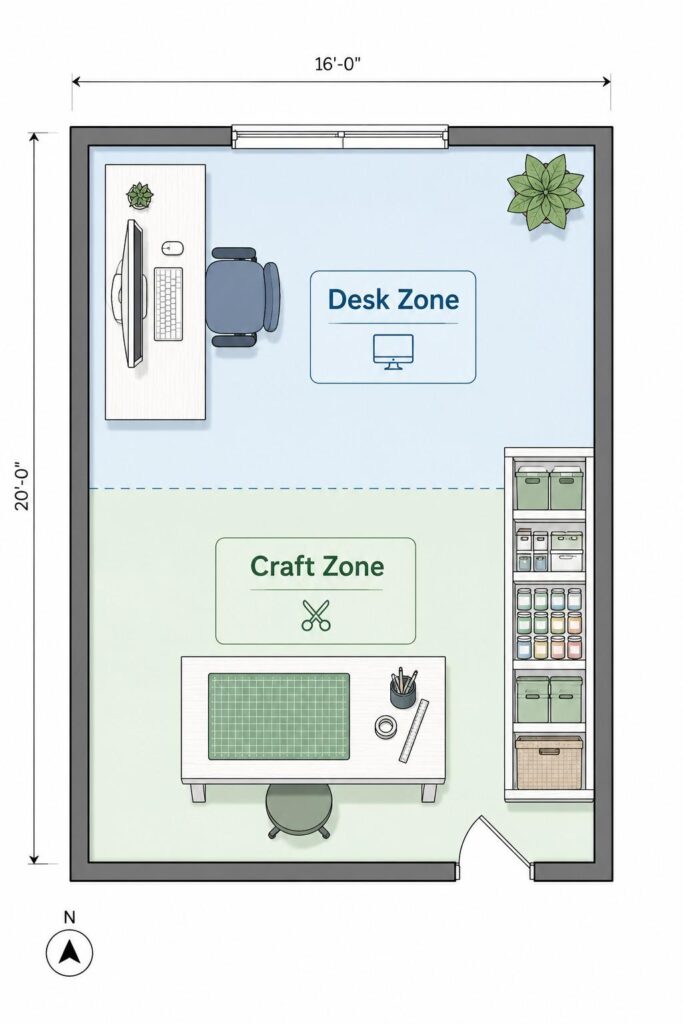
Most decorating guides jump straight to pretty photos. Before picking a color palette, spend ten minutes with a tape measure. Note the wall length available for a desk, the door swing, and where daylight falls, since crafting details like paint or fabric color need accurate light.
Next, separate “clean work” from “messy work.” Your laptop, files, and video-call setup belong in one zone; paint, glue, glitter, and fabric scraps belong in another, ideally on a surface you can wipe down. Even a narrow room can support this split using an L-shaped layout or a rolling cart that slides between two zones as needed.
Before buying furniture, it helps to see how other people solved the same square footage. Browsing a gallery of room makeover inspiration can surface furniture pairings you hadn’t considered, while a walkthrough of concrete diy projects shows exactly how shelving, desks, and lighting fit together step by step. For a more curated, design-led starting point, outinteriors rounds up layout templates and shopping lists built specifically for dual-purpose rooms like this one.
10 Craft Room Office Ideas for Every Style, Space, and Budget
1. Zone the Craft Room Office With Furniture, Not Walls
You don’t need construction to separate functions. A bookshelf, a credenza, or even a large plant can mark the boundary between the desk zone and the crafting zone. This keeps the room feeling open while still giving each activity a visual “edge,” which matters more for focus than most people expect.
2. Add a Vertical Grid Wall for Craft Storage
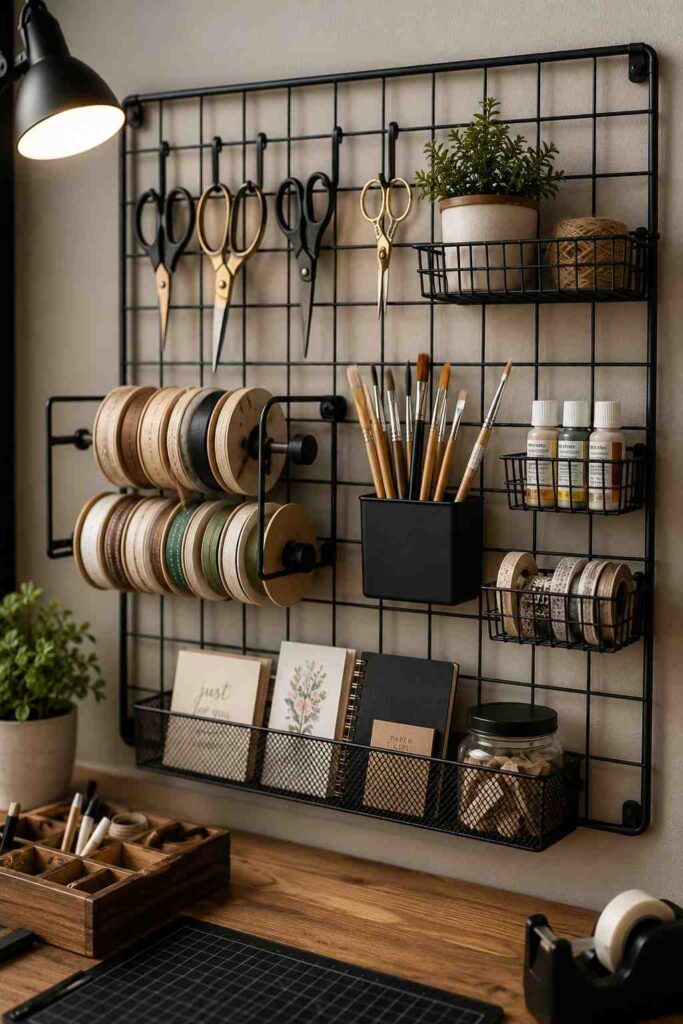
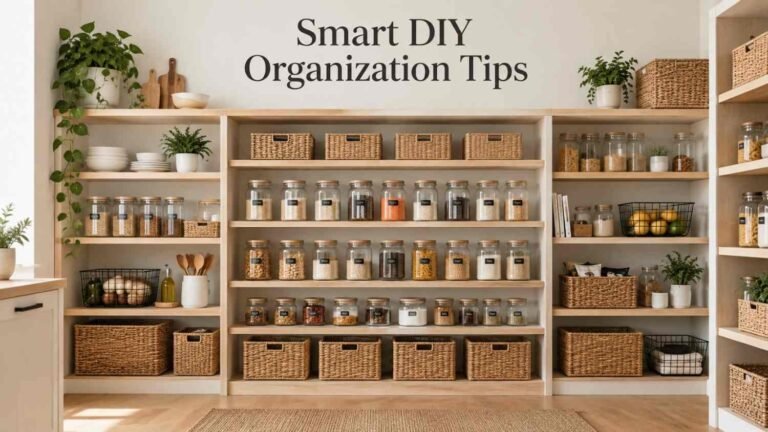
Floor space is limited, but wall space rarely is. A metal grid panel or pegboard mounted above the crafting surface holds scissors, ribbon, paint, and tools within reach while keeping the desk area clear. This single change tends to free up more usable surface than any other storage upgrade.
3. Choose One Dual-Purpose Desk
Rather than two separate tables, a single deep desk—at least 30 inches front to back—can host a laptop on one end and a cutting mat on the other. Look for a surface that’s easy to wipe clean, since paint and glue will inevitably meet the keyboard side eventually.
4. Convert a Closet Into a Mini Craft Room Office
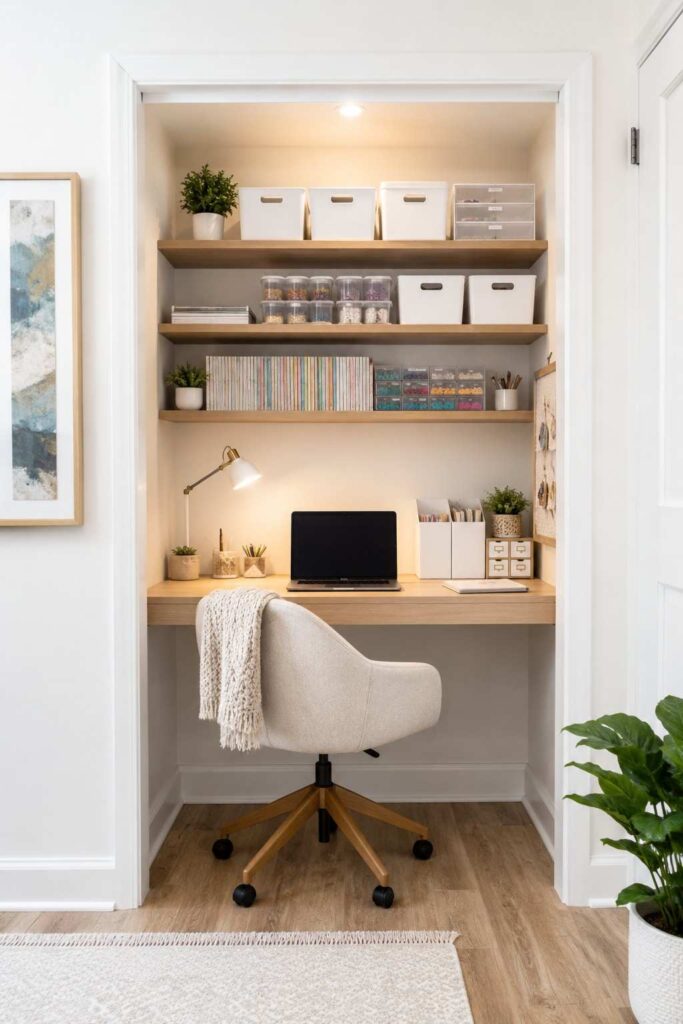
Small apartments have popularized the “cloffice,” a closet converted into a compact workstation. Remove the doors or swap them for bifolds, add a floating desk, and stack shelves above for supplies. It’s an efficient way to fit a full work-and-craft setup into a room that technically has no extra square footage.
5. Go Scandinavian for a Calm, Bright Shared Space
White walls, light wood, and closed storage keep visual clutter down, which matters in a room holding two categories of stuff. This style photographs well for video calls too, since the neutral palette doesn’t compete with whatever is happening on camera.
6. Bring in Industrial Materials for Heavy Crafting
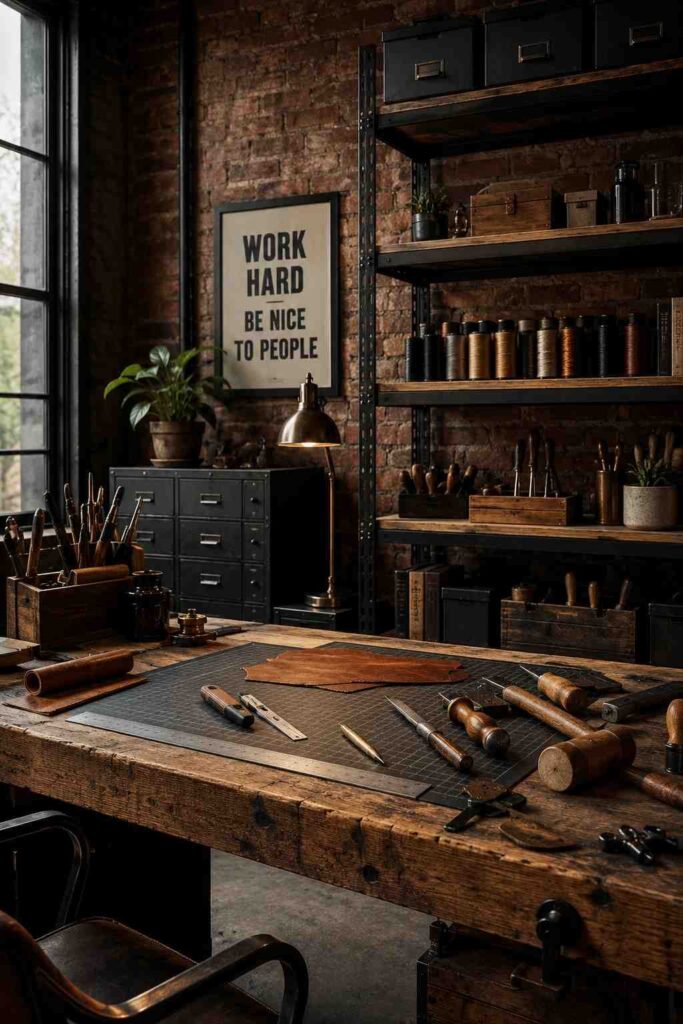
For woodworking, leatherwork, or jewelry making, exposed brick, black metal shelving, and a reclaimed wood desktop hold up better than delicate finishes. This look also tends to hide the inevitable scuffs that come with hands-on hobbies.
7. Warm It Up With Cottagecore Details
A floral accent wall, woven baskets, and warm task lighting create a room people actually want to sit in for hours. This style pairs especially well with writing, journaling, or fiber crafts where the atmosphere matters as much as the function.
8. Color-Code Every Bin and Drawer
Assign one color to office supplies and another to craft materials, then stick to it. This sounds simple, but it’s the fastest way to keep two categories of stuff from blending into one unsearchable pile, especially in households where more than one person uses the room.
9. Roll With Mobile Storage Carts
A cart on wheels—like a bar cart or a slim rolling drawer unit—can tuck under the desk during work hours and slide out for crafting sessions. It’s a low-cost way to add flexible storage without committing to built-ins, and it works in rentals where permanent installations aren’t an option.
10. Layer Lighting for Precision Work and Video Calls
Craft work needs strong, adjustable task lighting to judge color accurately; video calls need soft, even light that doesn’t wash out your face. A single overhead fixture rarely does both well. Pair an adjustable desk lamp near the crafting surface with a ring light or a window-facing desk position for calls.
Craft Room Office Budgets: What to Expect
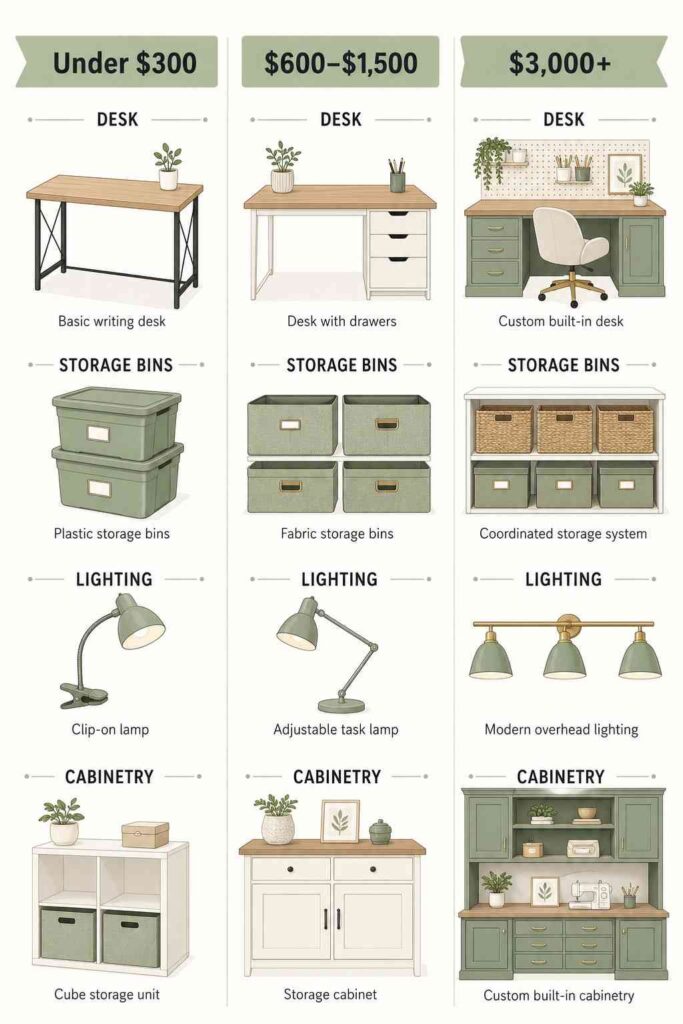
A workable dual-purpose setup doesn’t require a full renovation. At the low end, repurposing an existing desk, adding a few storage bins, and mounting an inexpensive pegboard can come in under $300. A mid-range refresh—new desk, task lighting, a rolling cart, and coordinated storage—typically lands between $600 and $1,500. Custom built-ins, a glass-top desk, and designer lighting push the high end past $3,000, though most of that cost goes toward cabinetry rather than decor. Setting a budget tier before shopping keeps the project from creeping upward, one “just one more bin” purchase at a time.
Safety and Maintenance: The Details Most Guides Skip
Mixing electronics with craft supplies introduces a few risks worth planning around. Keep hot tools—glue guns, irons, soldering equipment—away from cords and paper stacks, and give them a heat-safe landing pad. Store paints, solvents, and aerosols away from outlets and any equipment that generates heat. On the maintenance side, a five-minute reset at the end of each week—wiping the crafting surface and clearing the desk—keeps the two zones from merging into one chaotic pile, which is the single biggest complaint people have about shared spaces like this.
Can You Deduct a Craft Room Office on Your Taxes?
If part of your income comes from a home-based business, the IRS simplified home office deduction allows $5 per square foot, up to 300 square feet, for a maximum deduction of $1,500 per year. The catch that most guides skip: the space must pass the “exclusive use” test, meaning it’s used only for business, not for personal hobbies unrelated to that business. A room that’s half client invoicing and half personal scrapbooking may not qualify unless the crafting itself is part of the business, such as making products you sell. This isn’t tax advice—a qualified tax professional can confirm what applies to your specific situation.
Conclusion:
A craft room office works best when it’s planned like a small business operation, not just decorated like a mood board. Start with measurements and zoning, pick a style that matches how messy your hobby actually gets, and budget in tiers so the project doesn’t stall halfway through. Whether you end up with a closet-sized cloffice or a full room with built-in cabinetry, the goal is the same: a space where deadlines and creative projects can coexist without either one taking over the desk.
Frequently Asked Questions
What is a craft room office combo?
It’s a single room designed to handle both desk work and hobby crafting, usually with separate zones, shared storage, and furniture chosen to serve both functions at once.
How much space do I need for this kind of setup?
A functional setup can fit in as little as 50 square feet, such as a closet or narrow alcove. A more comfortable dual-zone layout typically needs 100 to 150 square feet.
Can I claim this shared space on my taxes?
Only if part of the space is used exclusively and regularly for a home-based business. Mixed personal and business use generally disqualifies the deduction—check with a tax professional.
What’s the best small-space solution for a combined work-and-craft room?
A converted closet, or “cloffice,” with a floating desk and stacked shelving is typically the most space-efficient option for apartments or smaller homes.
How do I keep a shared work-and-craft room organized?
Color-code storage by category, keep a wipeable surface for messy projects, and do a five-minute weekly reset so supplies don’t migrate between zones.
What lighting works best in a combined work-and-craft space?
A combination works best: adjustable task lighting for precision crafting, plus softer, even lighting positioned for video calls.
How much does a craft room office typically cost to set up?
Budget setups start around $300, mid-range refreshes run $600 to $1,500, and fully custom builds with cabinetry can exceed $3,000.