Narrow Hallway Ideas That Make a Tight Corridor Feel Wider, Brighter, and Full of Character
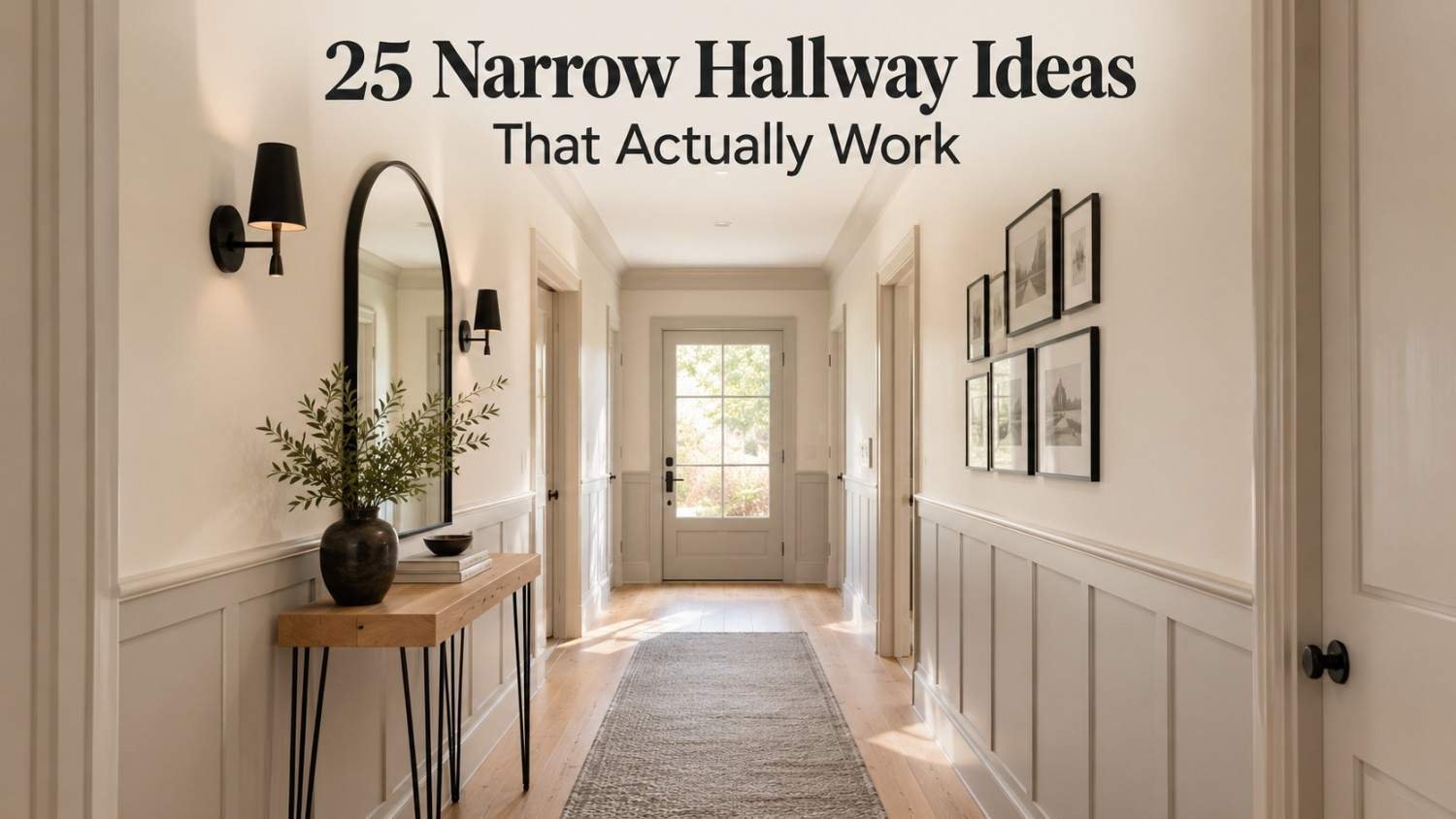
Every home has one: the skinny, forgotten stretch of floor between the front door and everything else. Most people walk through it a dozen times a day without ever looking up. But a hallway is prime real estate — it sets the tone before a guest even reaches the living room. If you’ve been searching for narrow hallway ideas that go beyond “just paint it white,” you’re in the right place. Below are 25 practical, tested ways to make a tight corridor feel wider, brighter, and genuinely worth decorating, plus the sizing rules, cost ranges, and mistakes most guides skip entirely.
How Wide Counts as “Narrow”? Know Your Numbers First
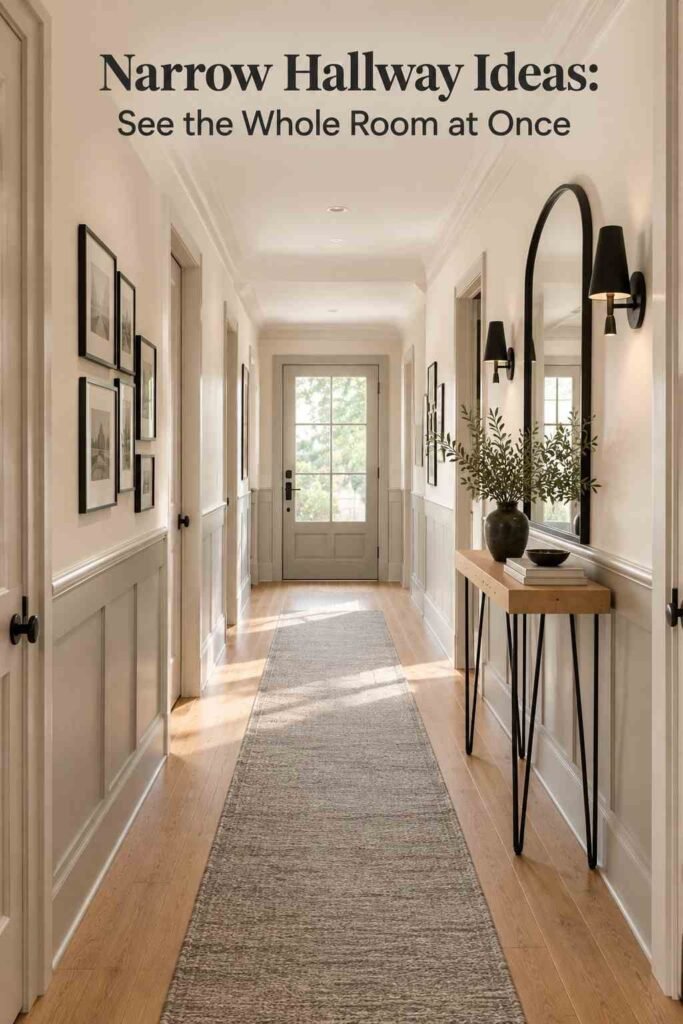
Before picking paint chips, it helps to know what you’re working with. Building codes in the U.S. typically require a minimum hallway width of 36 inches, while most designers consider 48 inches the point where a hall starts to feel comfortable rather than cramped. Anything under 42 inches is where most narrow hallway ideas become essential rather than optional, since there’s no room for error with furniture, door swings, or two people passing at once. Knowing your exact width first prevents you from buying a runner, console, or light fixture that makes the space feel even tighter.
Paint and Color Narrow Hallway Ideas
1. Skip Stark White for a Warm Off-White
Bright white is the default advice, but in a hallway with little natural light, cool white often turns flat and gray by midday. A warm off-white or soft greige holds up better under artificial light and still bounces brightness down the corridor.
2. Add a Two-Tone Wall With a Chair Rail
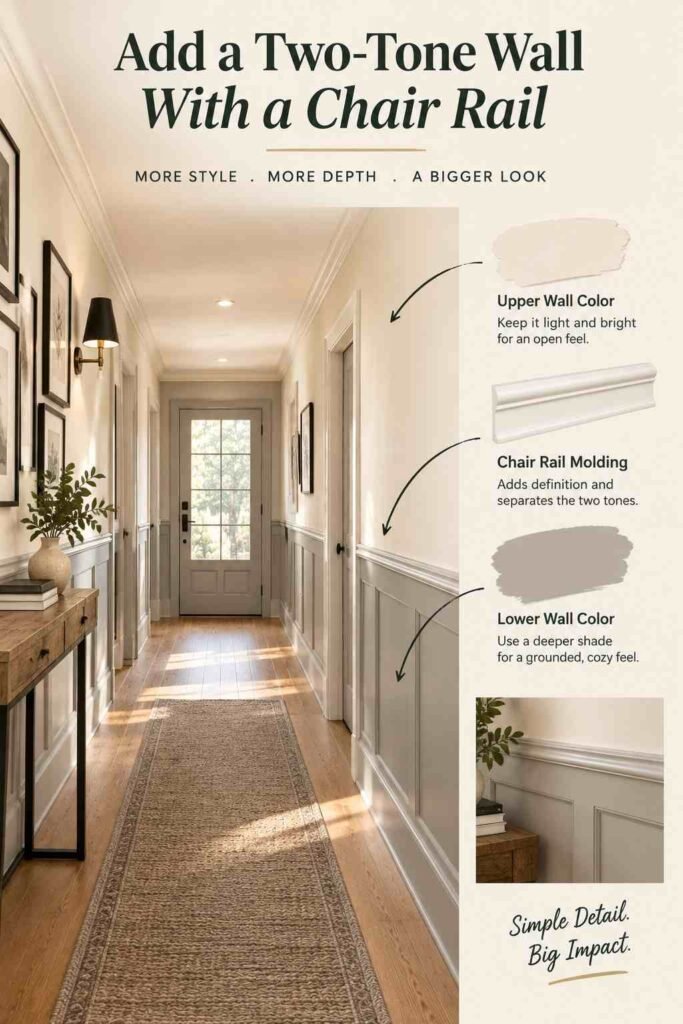
Splitting the wall with a chair rail and painting the lower half a slightly darker shade adds visual interest without shrinking the space. It also hides scuffs near shoe and bag height, which matters in a high-traffic zone.
3. Go Moody With a Dark, Saturated Color
Counterintuitively, a deep charcoal, forest green, or navy can make a short hallway feel intentional rather than cramped, especially when paired with brass hardware and layered lighting. This works best when the hallway connects to bright, open rooms at either end.
4. Paint the Ceiling a Soft Contrast Shade
Most people ignore the fifth wall. A ceiling painted a shade lighter or warmer than the walls draws the eye upward and outward, breaking the tunnel effect that plain white-on-white creates.
5. Use Vertical Lines or Panel Moulding
Vertical stripes, slatted wood panels, or picture-frame moulding trick the eye into reading height rather than narrowness, which is one of the simplest narrow hallway ideas for renters who can’t knock down walls.
Lighting Narrow Hallway Ideas
6. Layer Recessed Lights With Wall Sconces
A single overhead bulb creates harsh shadows in a tight space. Combining recessed ceiling lights with low wall sconces spreads light evenly along the walls, which visually pushes them outward.
7. Add Picture Lights Above Artwork
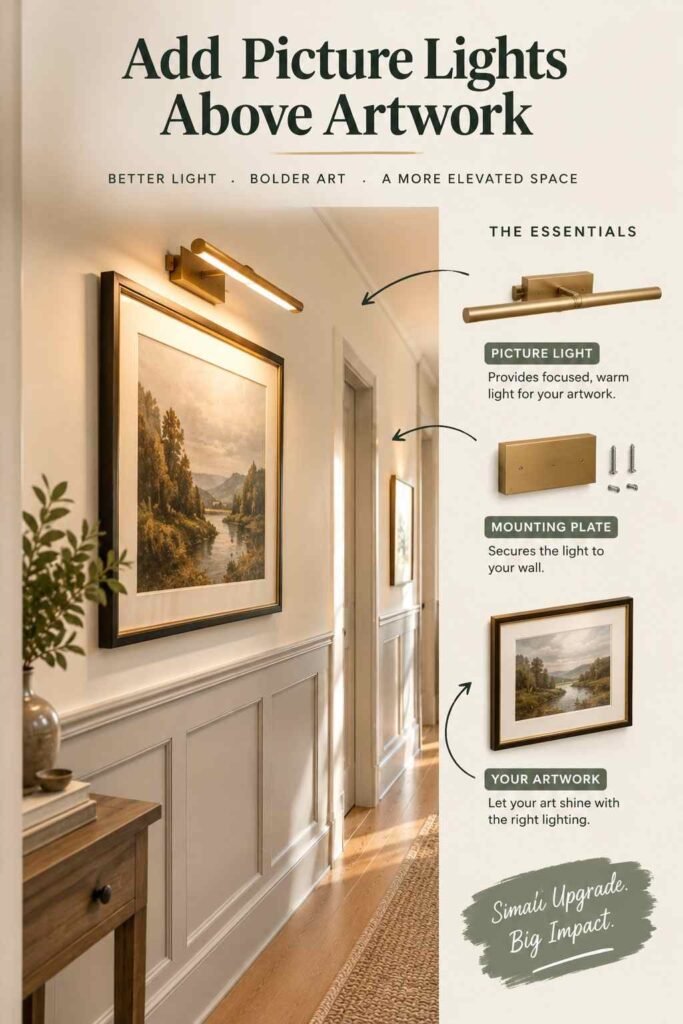
Small, angled picture lights do double duty: they highlight art and add a warm glow without eating into the already limited floor-to-ceiling space the way a floor lamp would.
8. Run a Row of Mini Pendants
Instead of one central fixture, a line of three or more small pendants spaced evenly down the ceiling elongates the corridor and guides the eye toward the far end, similar to how well-planned dining room lighting ideas use repetition to define a long table.
9. Install Dimmer Switches Everywhere
Dimmers let you shift from bright, functional light during the day to a softer glow at night, which matters more in hallways than almost any other room because they’re used at every hour.
Mirror and Reflective Narrow Hallway Ideas
10. Hang One Tall, Narrow Mirror
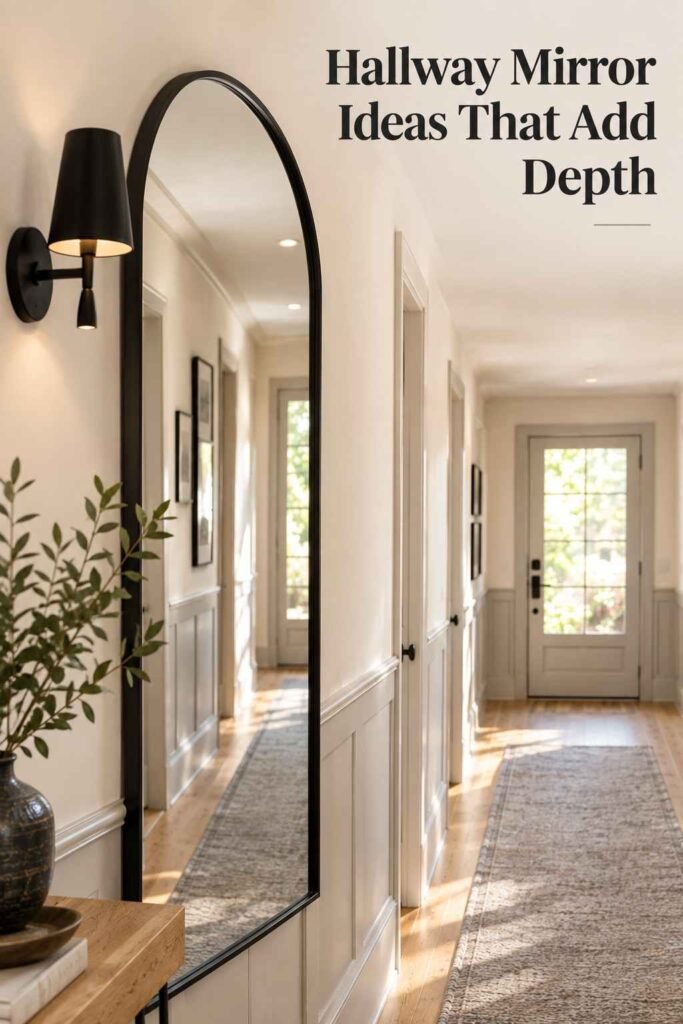
A single tall mirror placed opposite a light source doubles the perceived brightness and depth of the hall. Choose a mirror that’s narrower than the hallway itself — an oversized mirror in a tight space can highlight the width problem instead of solving it.
11. Build a Mirror Gallery Wall
Grouping several small mirrors of different shapes creates the reflective benefit of a single large mirror while adding texture and personality, a favorite among 2026 design trend lists for corridors with low natural light.
12. Consider a Smart Mirror With Built-In Lighting
Mirrors with integrated LED strips or motion sensors have become more affordable and give a narrow entry hallway a modern, functional upgrade for daily routines like checking your outfit before heading out.
Flooring and Rug Narrow Hallway Ideas
13. Size Your Runner Rug Correctly
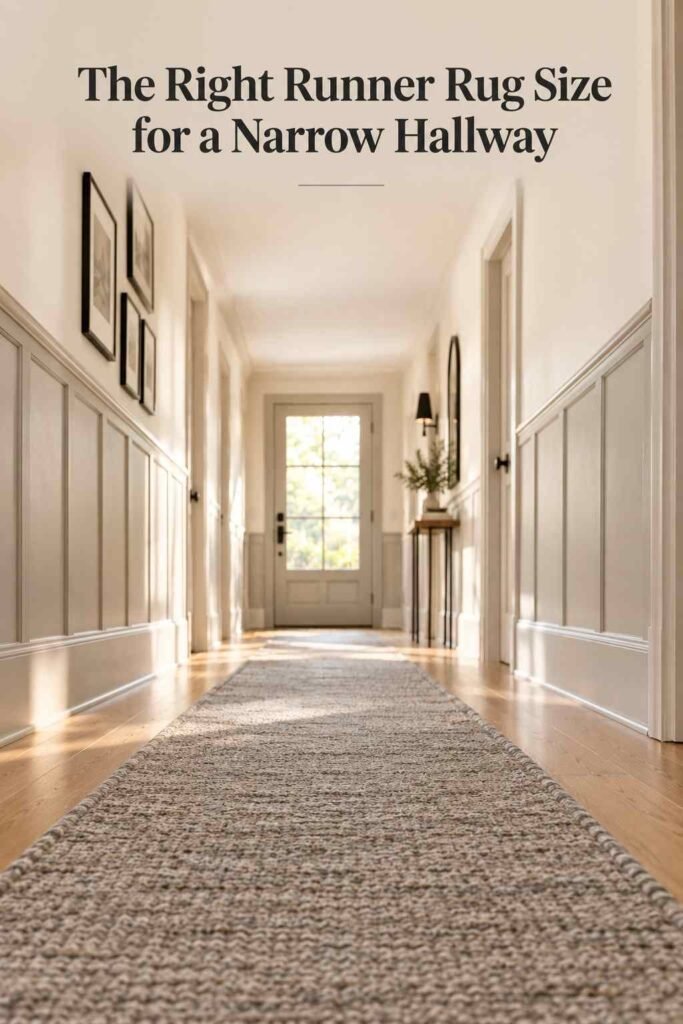
Rug sizing is where most narrow hallway ideas fall apart. As a general rule, short hallways suit a runner around 6 to 10 feet long, standard hallways work best with 10 to 14 feet, and longer corridors can handle 14 feet or more. Leave 3 to 4 inches of bare floor visible on each side of the rug so the hallway doesn’t look boxed in.
14. Lay Flooring on the Diagonal
Running hardwood, tile, or vinyl planks at a 45-degree angle instead of straight down the hall breaks up the tunnel-like sightline and makes the width feel less fixed.
15. Choose Durable, Low-Pile Materials
Hallways see more daily foot traffic than almost any other room. High-pile carpet and unsealed hardwood wear unevenly and show traffic paths fast, so a low-pile runner or sealed engineered wood holds up far longer.
Storage Narrow Hallway Ideas
16. Mount Floating Shelves Instead of Tables
Wall-mounted shelves keep the floor completely clear, which matters more in a narrow hallway than in any other room since even a few inches of floor clutter disrupts the walking path.
17. Choose a Slim Console Table
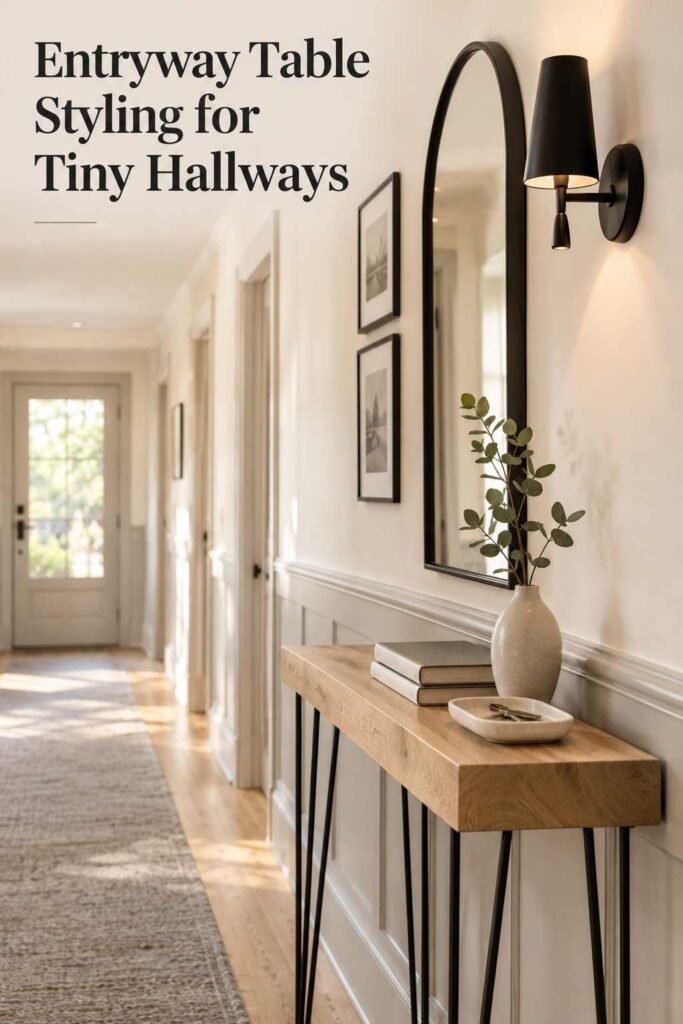
If you want a landing spot for keys and mail, look for a console under 12 inches deep with tapered or hairpin legs. Pairing it with a few curated pieces is where good entryway table decor ideas really pay off, since a cluttered surface undoes the benefit of a slim table.
18. Add a Wall-Mounted Ledge for Keys and Mail
A shallow floating ledge does the job of a console table without the floor footprint, making it one of the most space-efficient narrow hallway ideas for apartments.
19. Build a Bench With Hidden Storage
A slim bench with a lift-up seat gives you a place to sit while adding shoe or blanket storage underneath, without needing extra floor depth.
20. Use the Space Under the Stairs
If your hallway runs alongside a staircase, that triangular void is often wasted. Built-in drawers or a small nook here can absorb coats, shoes, and bags that would otherwise clutter the walls.
Wall Décor Narrow Hallway Ideas
21. Create a Gallery Wall of Small Frames
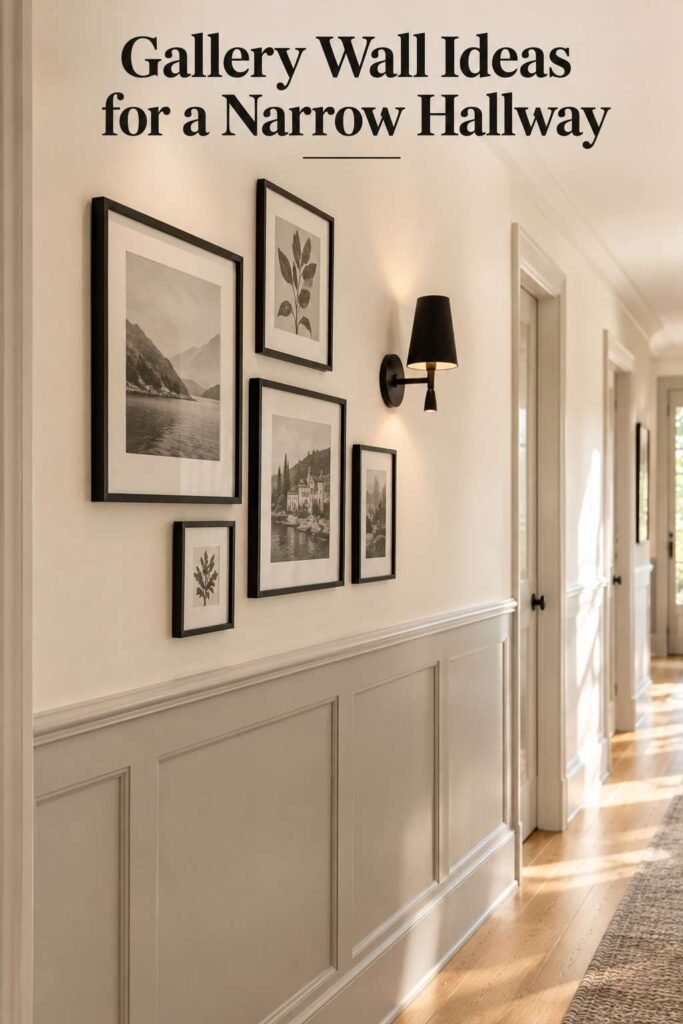
A cluster of smaller frames reads better in a tight corridor than one or two oversized pieces, which can visually shrink the walls they hang on.
22. Add Picture-Frame Moulding or Wainscoting
Raised panel moulding adds texture and a sense of architectural intention to a plain hallway, and it’s a budget-friendly project that can often be completed in a weekend.
23. Wallpaper One Feature Wall
A bold or textured wallpaper on the far end wall, rather than the long side walls, draws the eye forward and gives the hallway a destination point instead of feeling like an in-between space.
Architectural Narrow Hallway Ideas
24. Fix Door Swings With Pocket Doors
Doors that swing into a hallway eat up valuable clearance and can conflict with doors across from them. Swapping to pocket doors or doors that swing into the adjoining room frees up several inches of usable width.
25. Add Glass Panels or Transom Windows for Light
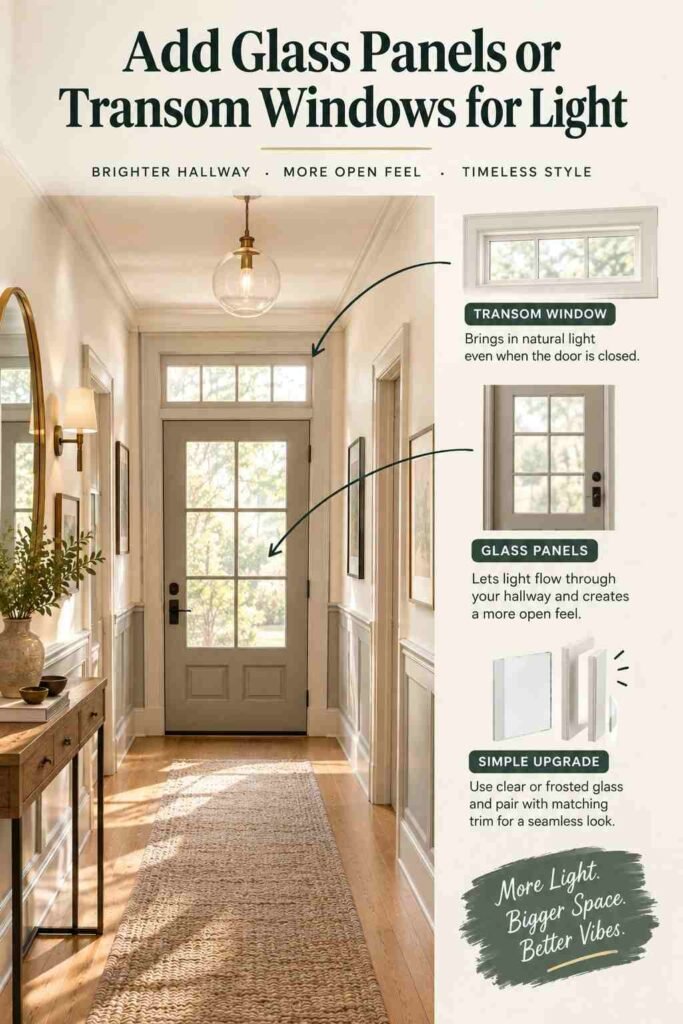
Where privacy isn’t a concern, a glass panel door or transom window borrows light from an adjacent room, cutting down on how much the hallway depends on artificial lighting during the day.
Narrow Hallway Mistakes That Make the Space Feel Smaller
A few habits undo even the best narrow hallway ideas. Common ones include hanging oversized art that overwhelms the wall, placing deep furniture that narrows the walking path below 36 inches, choosing a runner that’s too short or too wide for the space, relying on a single harsh overhead bulb, and assuming plain white paint is always the safest choice. Each of these seems minor on its own, but in a corridor with almost no room for error, small missteps are far more noticeable than they would be in a larger room.
How Much Does It Cost to Refresh a Narrow Hallway?
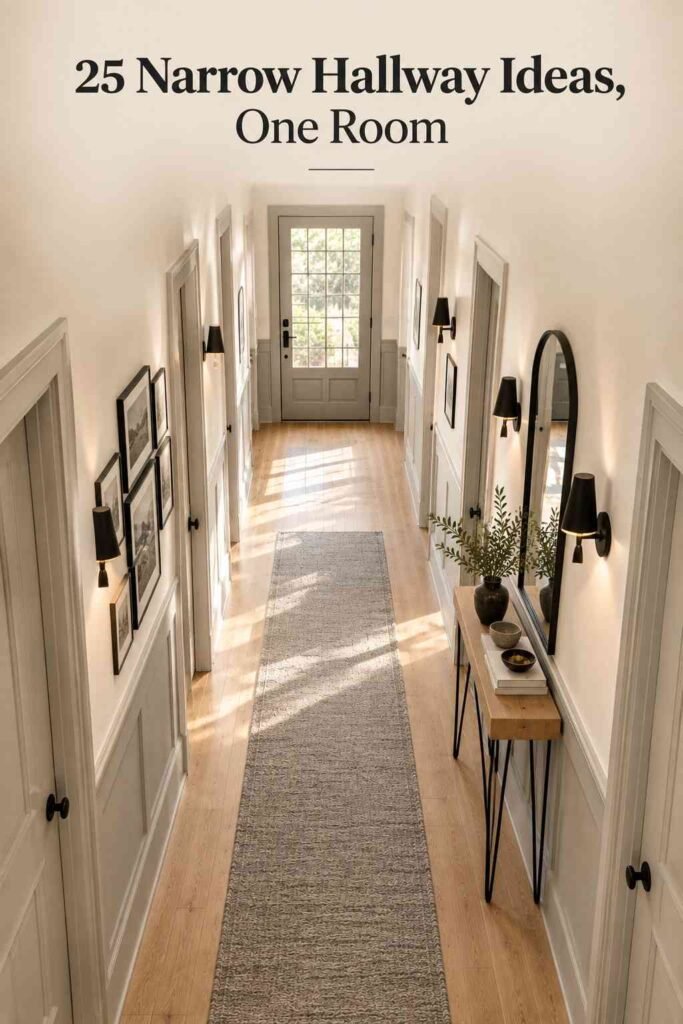
Budget shapes which narrow hallway ideas make sense for your home. A paint refresh, new hardware, and a runner rug typically fall under $300 and can be done in a weekend. Adding layered lighting, a slim console, and wall art usually lands between $300 and $900, depending on fixture quality. Larger updates like picture-frame moulding, built-in benches, or swapping doors for pocket doors generally start around $800 and climb from there based on labor costs. Starting with paint and lighting gives the biggest visual return for the smallest investment.
Final Thoughts
A narrow hallway doesn’t have to stay an afterthought. With the right combination of paint, lighting, mirrors, and slim furniture, even a 36-inch-wide corridor can feel intentional, warm, and functional rather than cramped. Start with one or two changes — a better light layer and a correctly sized rug make the biggest difference for the least effort — and build from there. For more room-by-room inspiration, browse the full collection of design guides on OutInteriors.
Frequently Asked Questions About Narrow Hallway Ideas
1. What is the best color for a narrow hallway?
Warm off-whites, soft greiges, and light neutrals generally work best because they reflect available light without turning cold or gray. Darker, saturated colors can also work well if the hallway connects to bright rooms at either end.
2. How do I make a narrow hallway look wider without renovating?
Focus on layered lighting, a correctly sized runner rug, and a tall mirror placed opposite a light source. These three changes make the biggest visual impact without any structural work.
3. What size rug should I use in a narrow hallway?
Leave 3 to 4 inches of bare floor on each side of the runner, and match the length to the hallway: shorter halls suit 6 to 10 feet, standard halls work with 10 to 14 feet, and longer corridors can handle 14 feet or more.
4. Is it better to use one large mirror or several small ones?
Both work, but a single mirror should be narrower than the hallway itself to avoid emphasizing the tight width. A gallery of smaller mirrors offers similar brightness with more texture.
5. What furniture works in a very narrow hallway?
Slim console tables under 12 inches deep, floating shelves, and wall-mounted ledges are the safest choices, since anything deeper than about 12 inches starts to interfere with comfortable walking clearance.
6. How much does it typically cost to update a narrow hallway?
A basic refresh with paint, hardware, and a rug usually costs under $300, while adding lighting and furniture can bring the total to $300–$900. Structural changes like new doors or built-ins start around $800.
7. Should a narrow hallway always be painted white?
No. While white is a common default, it can look flat or gray in hallways with limited natural light. Warm neutrals or even moody darker tones often perform better in practice.