
Tax Deductible Home Improvements: The Complete Homeowner’s Guide for 2025

You’ve just finished a major renovation — new windows, an upgraded HVAC system, maybe even a freshly built home office. The contractor’s bills are paid. Now comes the question almost every homeowner eventually asks: tax deductible home improvements
The honest answer is more nuanced than a simple yes-or-no. Not every renovation qualifies for an immediate write-off, but a surprising range of home improvements can reduce what you owe — either right now or when you eventually sell. Understanding the IRS rules can mean the difference between leaving thousands of dollars on the table and keeping them in your pocket.
This guide breaks down every major category of tax-deductible home improvements, explains exactly how each one works, and shows you which forms to file. Whether you’re a first-time homeowner or a seasoned property investor, you’ll find everything you need here.
Why Most Home Improvements Are Not Immediately Deductible
Before exploring what qualifies, it helps to understand the IRS’s basic framework. The IRS draws a clear line between repairs and improvements.
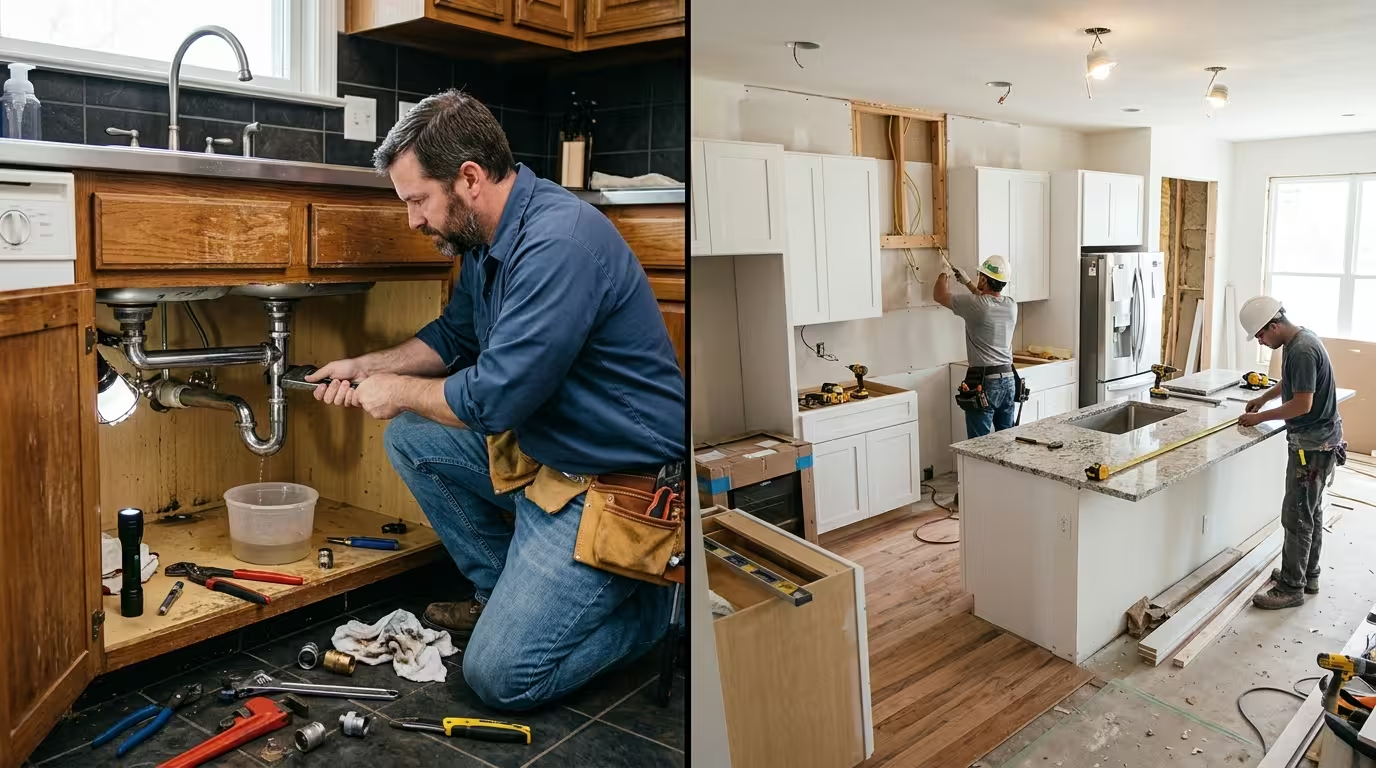
A repair keeps your home in ordinary working condition — patching a roof, fixing a leaky faucet, or repainting the exterior. The IRS does not consider repairs to be capital investments, and for most primary-residence homeowners, repair costs cannot be deducted in the year they occur.
An improvement, by contrast, substantially adds value to your home, prolongs its useful life, or adapts it to a new use. Adding a deck, replacing all the windows, or installing a new HVAC system are classic examples. These are capital improvements — and while they may not give you an immediate line-item deduction, they carry meaningful long-term tax benefits that can be well worth planning for.
The Four Main Categories of Tax-Deductible Home Improvements
1. Capital Improvements That Reduce Capital Gains Tax
Capital improvements don’t produce an immediate deduction on your annual return — but they quietly work in your favor over time. Every qualifying improvement you make gets added to your home’s cost basis, which is essentially what the IRS treats as the total amount you’ve invested in the property.
Here’s why that matters. When you sell your home, your taxable gain is calculated as:
Sale Price − Cost Basis = Taxable Gain
The higher your cost basis, the lower your taxable gain. And a lower taxable gain means less capital gains tax — or possibly none at all.
The IRS allows single filers to exclude up to $250,000 in home-sale profit from taxes, and married couples filing jointly can exclude up to $500,000, provided they’ve owned and lived in the home for at least two of the five years before the sale. For many homeowners, capital improvements help keep the taxable portion of any gain within — or below — that exclusion threshold.
Examples of qualifying capital improvements include:
- Adding a new room, garage, or accessory dwelling unit (ADU)
- Installing a new roof or replacing all siding
- Finishing a basement or attic
- Building a deck or an in-ground swimming pool
- Replacing all windows and exterior doors
- Installing central air conditioning or a new HVAC system
- Landscaping projects that permanently alter the property
- Complete kitchen or bathroom remodels
Pro tip: Save every receipt, contractor invoice, and bank statement from the day you purchase your home. The IRS requires documentation to substantiate any additions to your cost basis.
2. Energy-Efficient Home Improvements — Credits You Can Claim Now

This is where tax-deductible home improvements get genuinely exciting for most homeowners, because energy-related upgrades often qualify for immediate tax credits — money taken directly off your tax bill, not just your taxable income.
Under the Energy Efficient Home Improvement Credit — established through the Inflation Reduction Act — homeowners can claim a credit equal to 30% of qualifying upgrade costs, up to $3,200 per year, for improvements made through December 31, 2025.
The $3,200 annual cap breaks down into two tiers:
Up to $1,200 per year for:
- Exterior doors ($250 per door; $500 total)
- Exterior windows and skylights ($600 total)
- Insulation and air sealing materials
- Home energy audits (up to $150)
- Certain energy-efficient central air conditioners, water heaters, and furnaces
Up to $2,000 per year for:
- Qualified heat pumps
- Heat pump water heaters
- Biomass stoves and biomass boilers
Important: This credit has no lifetime cap. You can claim the full allowable credit each year through 2025, provided you install new qualifying property. To claim it, file IRS Form 5695 (Residential Energy Credits, Part II) with your tax return for the year the property was installed, not simply purchased
Solar Panels and Renewable Energy: The Residential Clean Energy Credit
Solar energy systems occupy their own distinct credit category. The Residential Clean Energy Credit allows homeowners to claim 30% of the total installation cost of qualifying renewable energy systems — including solar panels, solar water heaters, wind turbines, geothermal heat pumps, and battery storage systems — with no annual dollar cap.
This credit is available through 2032, making solar panel installation one of the most financially rewarding tax-deductible home improvements currently available to American homeowners. Unlike the energy efficiency credit above, this credit can be carried forward to future tax years if it exceeds what you owe in the current year.
3. Medical Home Improvements — Deducting Accessibility Modifications

Many homeowners overlook this category entirely, but medically necessary home modifications can qualify as deductible medical expenses under IRS Publication 502 — and the list of qualifying improvements is broader than most people expect.
If you, your spouse, or a dependent living with you has a disability or medical condition that requires modifications to your home, those costs may be deductible as medical expenses. The key requirement: the primary purpose of the modification must be medical or functional, not aesthetic or general property improvement.
The IRS specifically recognizes the following accessible home modifications:
- Constructing entrance or exit wheelchair ramps
- Widening doorways and hallways to accommodate wheelchairs
- Installing grab bars, railings, or support bars in bathrooms
- Lowering or modifying kitchen cabinets and countertops
- Moving or modifying electrical outlets and light fixtures
- Installing stair lifts or porch lifts
- Modifying fire alarms and smoke detectors for hearing-impaired residents
- Adding handrails anywhere in the home
- Grading the ground to provide wheelchair access
The 7.5% AGI threshold: Medical expense deductions — including these home modifications — are only deductible to the extent that total medical expenses exceed 7.5% of your adjusted gross income (AGI). This means if your AGI is $80,000, only medical expenses above $6,000 can be deducted. To take advantage of this, you must also itemize deductions on Schedule A rather than taking the standard deduction.
One more nuance to understand: If a modification increases your home’s market value, only the portion of the cost that exceeds the increase in value is fully deductible as a medical expense. For example, if adding an accessible bathroom costs $30,000 but raises your home’s value by $12,000, you can deduct $18,000 as a medical expense (subject to the 7.5% AGI floor). Modifications that don’t increase your home’s value — such as widening a doorway — are generally fully deductible.
To support your claim, have your physician provide written documentation confirming the medical necessity of each modification before beginning the work.
4. Home Office Improvements
With remote work now a fixture of American professional life, the home office deduction has become increasingly relevant. However, the IRS applies strict eligibility requirements that many workers do not meet.
Who qualifies: Self-employed individuals and sole proprietors who use a specific, dedicated area of their home regularly and exclusively for business purposes. W-2 employees who work remotely do not qualify for this deduction, even if their employer requires them to work from home full-time.
For those who do qualify, improvements made to the portion of your home used as an office may be deductible — either in the year incurred (for repairs) or depreciated over time (for capital improvements). The deductible percentage is based on the ratio of your home office square footage to your total home square footage.
For example, if your home office occupies 10% of your home’s total square footage, you could potentially deduct 10% of qualifying home improvement costs that benefit the entire property (such as a new roof or HVAC system), plus 100% of improvements made exclusively to the office space itself.
Rental Property: A Different — and More Generous — Set of Rules

If you own and rent out a property, the tax treatment of improvements and repairs is notably more favorable than for a primary residence.
Repairs — painting, fixing a broken appliance, repairing plumbing — are generally fully deductible in the year they occur for rental property owners. They are treated as ordinary business expenses.
Capital improvements to rental properties — roof replacements, bathroom remodels, room additions — must be capitalized and depreciated over 27.5 years (the IRS recovery period for residential rental property). This means you deduct a portion of the improvement cost each year across that period rather than all at once.
However, under recent tax law changes, certain shorter-lived assets within a rental (such as appliances, flooring, or fixtures) may qualify for 100% bonus depreciation, allowing immediate full deduction in the year they’re placed in service. The One Big Beautiful Budget Act (OBBBA), passed in 2025, made 100% bonus depreciation permanent for qualifying assets placed in service after January 19, 2025 — a significant win for rental property owners and investors.
Using Home Equity Financing for Tax-Deductible Home Improvements
If you’re funding renovations with a home equity loan or home equity line of credit (HELOC), there’s an additional tax benefit worth knowing about. The interest paid on these loans may be deductible — but only when the funds are used to buy, build, or substantially improve the home that secures the loan.
Using HELOC funds for a kitchen remodel or room addition? That interest may be deductible. Are you using the same funds for a vacation or a car purchase? That interest is not deductible under current IRS rules. This is a nuance many homeowners miss, and it makes earmarking renovation funds carefully a smart financial practice.
Historic Home Restorations
Owners of certified historic structures may qualify for the Historic Tax Credit, which provides a 20% federal tax credit on qualifying rehabilitation expenses. To be eligible, the property must be listed on the National Register of Historic Places or be located in a registered historic district. The work must also be certified as consistent with the historic character of the building. This is a niche but powerful incentive for homeowners passionate about restoring older properties.
What Does NOT Qualify as a Tax Deductible Home Improvement
Understanding the boundaries is just as important as knowing the benefits. The following projects generally do not qualify for any immediate federal tax deduction for primary-residence homeowners:
- Interior painting (unless part of a larger qualifying renovation)
- Landscaping for purely aesthetic purposes
- Replacing broken windows (classified as a repair, not an improvement)
- Installing a new fence
- Purchasing general household appliances (refrigerators, dishwashers) for a primary home
- General cleaning, pest control, or routine maintenance
- Swimming pool installation for recreational use only (though this can be added to the cost basis)
Record-Keeping: The Habit That Protects Your Deductions
Documentation is the single most important habit a homeowner can build. The IRS requires proof for every claim you make — and the burden of proof falls on you, not the agency.
For every improvement, keep:
- Original contractor bids and signed contracts
- Itemized invoices and receipts
- Bank statements and credit card records showing payments
- Before-and-after photographs were possible
- Manufacturer’s certification statements for energy-efficient products
- Doctor’s letters for medically necessary modifications
- Appraisal reports if a modification affects your home’s value
Store both physical copies and digital backups. Given that many improvements affect your cost basis and won’t produce a tax benefit until you sell — potentially decades later — these records need to last the life of your homeownership.
Quick Reference: Tax Benefits by Improvement Type
|
Improvement Type |
Tax Benefit |
When You Benefit |
|
Capital improvements (roof, addition, remodel) |
Increases cost basis; reduces capital gains |
When you sell |
|
Energy-efficient windows, doors, and insulation |
Up to $1,200 annual credit (30%) |
Current tax year |
|
Heat pumps, heat pump water heaters |
Up to $2,000 annual credit (30%) |
Current tax year |
|
Solar panel system |
30% credit, no cap (through 2032) |
Current tax year |
|
Medical accessibility modifications |
Deductible as medical expense (above 7.5% AGI) |
Current tax year |
|
Home office improvements (self-employed) |
Proportional deduction or depreciation |
Current tax year |
|
Rental property repairs |
Fully deductible |
Current tax year |
|
Rental property capital improvements |
Depreciated over 27.5 years |
Over time |
|
Historic home rehabilitation |
20% federal tax credit |
Current tax year |
|
HELOC interest (for qualifying improvements) |
Mortgage interest deduction |
Current tax year |
Conclusion
Tax-deductible home improvements are one of the most underutilized financial tools available to American homeowners. The landscape spans immediate energy credits, long-term capital gains reductions, medical accessibility write-offs, and generous rental property rules — each with its own eligibility requirements and maximum benefit.
The single most important step you can take today is to begin documenting every improvement you make, no matter how small it seems. Whether you’re installing solar panels this spring, converting a room into a dedicated office, or making your home more accessible for a family member, the IRS rewards homeowners who are informed and well-documented.
When in doubt, consult a licensed CPA or enrolled agent before filing. Tax laws change — as the energy credit expiration at the end of 2025 reminds us — and a qualified professional ensures you capture every benefit available for your specific situation.