Black Wall Living Room Ideas That Bring Bold, Timeless Style Home

Walk into any design showroom in 2026, and you’ll notice a pattern: rooms with a single dark, confident wall get all the attention. A black wall living room has moved far past “trend” status — it’s become a design staple that works in lofts, ranch homes, and tiny city apartments alike. The idea sounds intimidating on paper, but in practice, black walls do something few other colors can. They add depth, frame furniture like a gallery frames art, and make every other color in the room look more intentional.
This guide breaks down exactly how to plan, paint, and style a black wall in your living room, plus 25 real, usable ideas organized by style so you can find the one that fits your space — not just a pretty picture to scroll past.
Why a Black Wall Living Room Works in Any Home
The biggest myth about a black living room wall is that it will make a space feel smaller or darker overall. In reality, a dark wall recedes visually when it’s balanced with light furniture, natural materials, and good lighting — it creates depth rather than closing a room in. Designers often compare it to a piece of matte photography paper: dark backgrounds make everything placed against them look sharper and more defined.
Black also functions as a neutral. Unlike a saturated color such as terracotta or navy, black doesn’t compete with wood tones, metals, or patterns. That’s why a black wall living room pairs just as easily with a mid-century sofa as it does with a farmhouse sectional or a glam velvet chaise.
How to Choose the Right Black Paint for Your Living Room Wall
Not every black is created equal, and this is where most homeowners get tripped up. Paint brands measure how much light a color reflects using LRV (Light Reflectance Value) — a scale from 0 (absolute black) to 100 (pure white). True blacks sit around an LRV of 2 to 4, while charcoal-leaning “almost blacks” run closer to 6 to 9, which can be a gentler starting point if you’re nervous about full commitment.
Warm vs. Cool Black Undertones
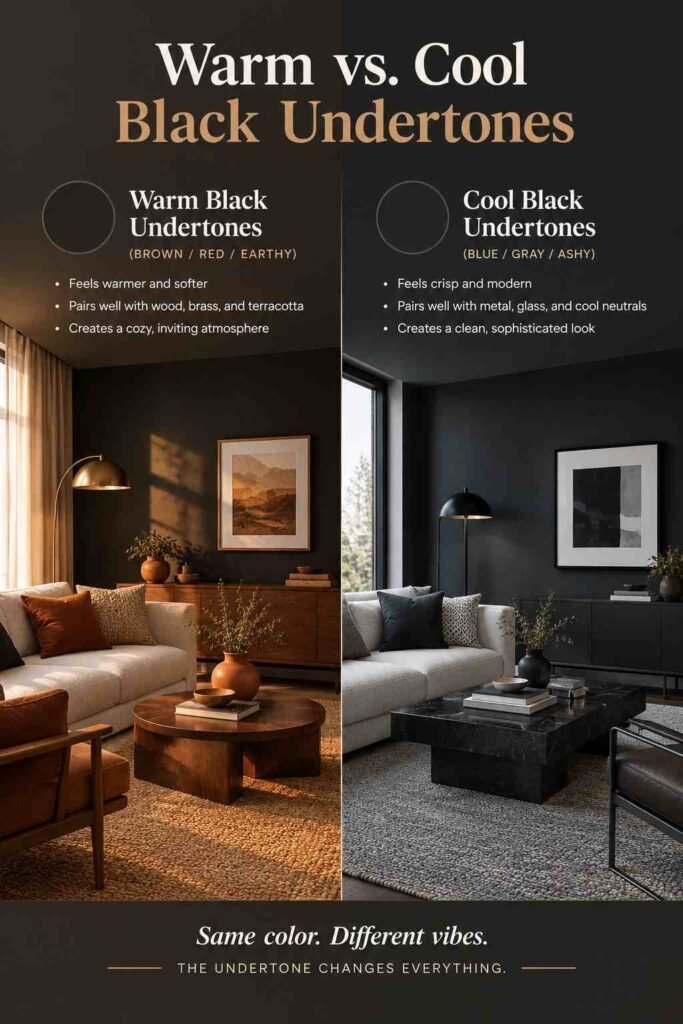
Black paint isn’t neutral in the way you’d expect. Warm blacks carry a hint of brown or red and pair beautifully with wood floors and brass hardware. Cool blacks lean blue, green, or violet and feel sharper next to chrome, marble, and white trim. Testing a sample patch at different times of day is the only reliable way to see which undertone your room’s natural light brings out.
Top Black Paint Colors Designers Recommend
A few shades come up again and again in professional projects:
- Benjamin Moore Onyx (2133-10) — LRV 2.9, a true, neutral black with a faint blue-black undertone.
- Benjamin Moore Wrought Iron (2124-10) — LRV 6.2, a softer charcoal-black that reads black in low light.
- Benjamin Moore Soot (2129-20) — a gray-leaning black that feels warm rather than stark.
- Sherwin-Williams Tricorn Black (SW 6258) — one of the most popular true blacks for accent walls.
- Sherwin-Williams Iron Ore (SW 7069) — a deep, moody near-black with a subtle green undertone.
- Sherwin-Williams Inkwell (SW 6992) — LRV 4, a cooler black with blue depth, well suited to living rooms and libraries.
Picking the Right Sheen for a Black Accent Wall
Sheen matters as much as color. Matte and flat finishes hide wall imperfections and give black its signature moody, velvety look, but they mark more easily. Eggshell or satin finishes are more washable and slightly more forgiving for high-traffic living rooms, at the cost of a bit more shine that can show glare under overhead lighting. For most living rooms, a high-quality matte or “flat enamel” designed for washability offers the best balance.
25 Black Wall Living Room Ideas to Try at Home

Here are 25 distinct ways to bring a black wall living room to life, grouped by the mood you’re going for.
Minimalist & Modern Black Wall Living Room Ideas
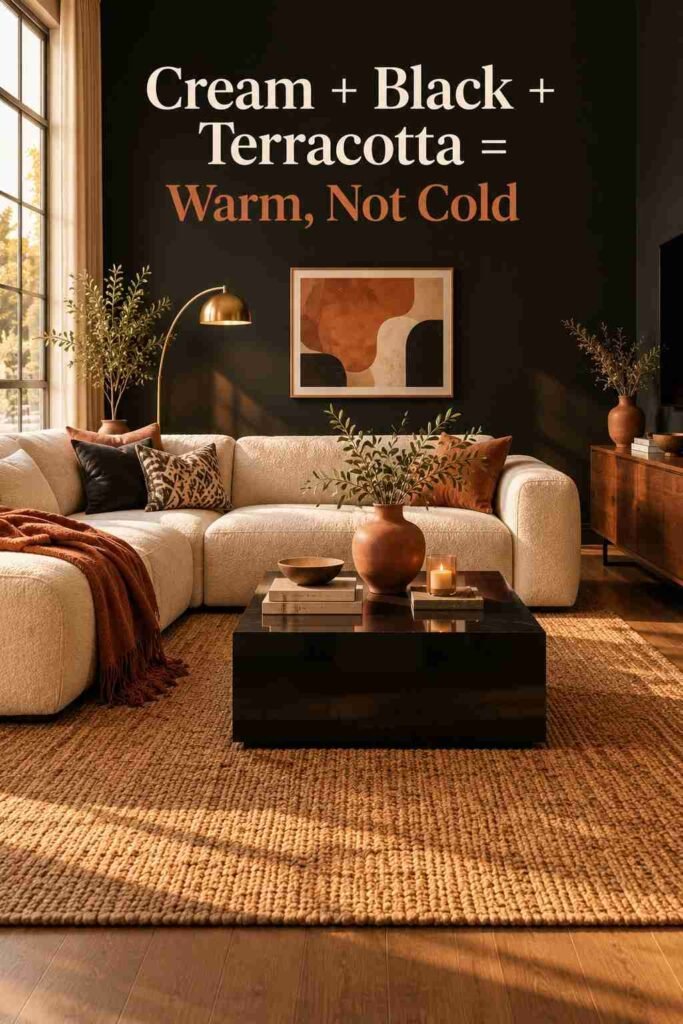
- Matte black backdrop with a single statement art piece — one oversized canvas does more work than a cluttered gallery.
- Black wall paired with a neutral bouclé sofa — the contrast in texture keeps the palette from feeling flat.
- Black half-wall for subtle definition — painting only the lower two-thirds adds depth without darkening the whole room.
- Monochrome black-and-white gallery wall — framed prints in black-and-white frames disappear into the color, creating a floating-art effect.
- Black wall behind open shelving

Books and objects pop forward instantly against the dark plane.
Cozy & Warm Black Wall Living Room Ideas
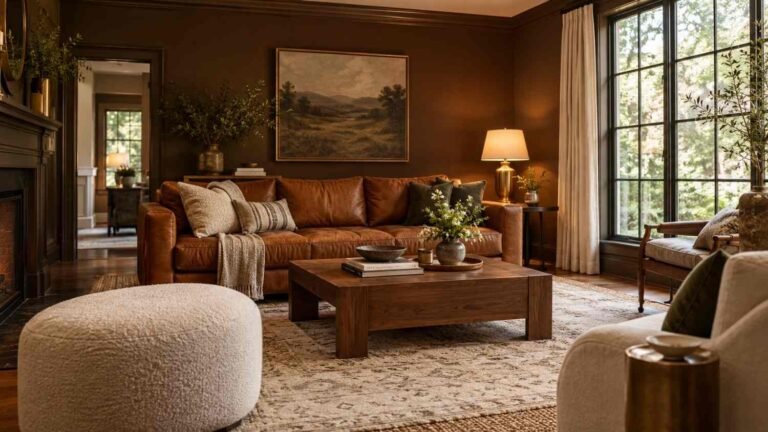
- Black wall with warm wood built-ins — walnut or oak shelving softens the drama and adds instant warmth.
- Black accent wall behind a stone or brick fireplace — the dark tone makes the fireplace itself the room’s focal point.
- Layered textiles against a black wall — wool throws, corduroy pillows, and a jute rug prevent the space from feeling cold.
- Black wall with rattan and wicker accents — natural woven textures add an earthy, lived-in counterbalance.
- Candlelit black wall reading nook
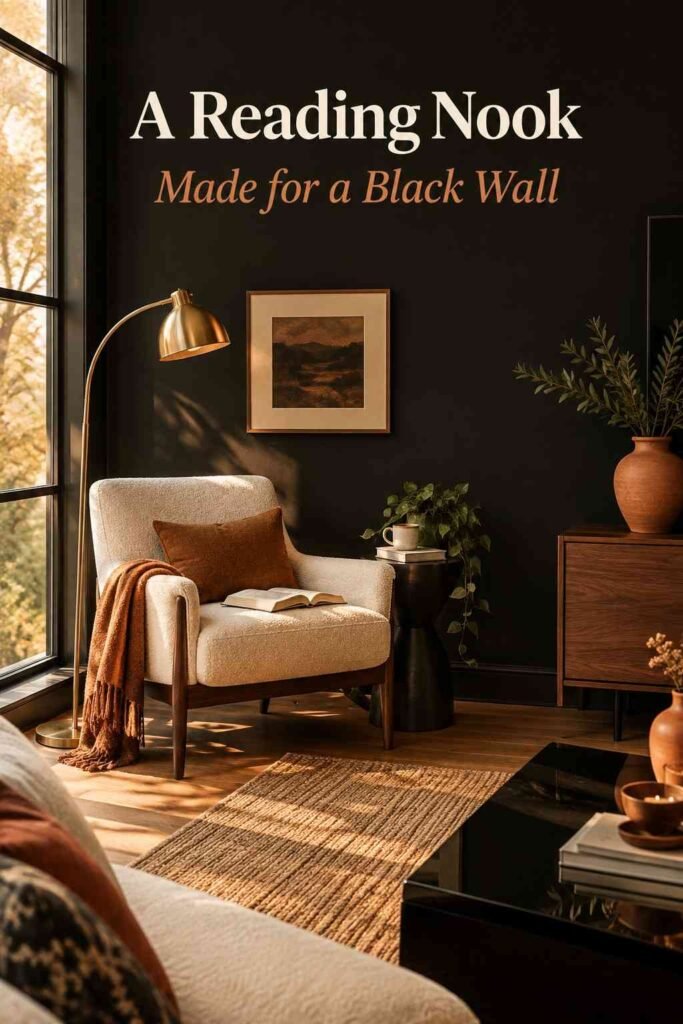
A single armchair, a floor lamp, and low light turn one wall into a retreat.
Glam & Luxe Black Wall Living Room Ideas
- Black wall with brass or gold fixtures — warm metals against black read expensive without much effort.
- Velvet furniture against a black feature wall

Deep emerald or blush velvet seating adds jewel-toned richness.
- Black wall with a statement chandelier — the dark backdrop makes crystal or sculptural lighting the clear centerpiece.
- Mirrored furniture paired with a black wall — reflective surfaces bounce light and prevent the glam look from feeling heavy.
- Black wall with a marble-top console table — cool veining against matte black is a classic high-contrast pairing.
Small Space Black Wall Living Room Ideas
- Single black accent wall to add depth without shrinking the room — this is the safest entry point for smaller layouts.
- Black wall painted behind a window — it frames the outdoor view like a piece of art rather than closing the space in.
- Black wall with floor-to-ceiling curtains

Hanging drapery just below the ceiling line tricks the eye into reading a taller room.
- Black wall paired with a large mirror — this bounces natural light back across the room, offsetting the depth of the color.
- Black wall in a studio or open-concept living room — using it to visually separate the lounge zone from a kitchen or dining area works well without adding a physical wall.
Statement & Architectural Black Wall Living Room Ideas
- Board-and-batten black accent wall — raised molding painted black adds texture that flat paint alone can’t achieve.
- Black wall with vertical wood slats — slatted paneling softens the starkness of solid black while adding architectural interest.
- Black wall as a TV backdrop — it minimizes glare and makes the screen blend into the wall when it’s off.
- Black limewash or textured plaster wall — a mineral, cloud-like finish gives black depth instead of a flat, uniform look.
- Black wall extending onto the ceiling — this “color-drenching” technique, popular in newer builds, makes ceilings feel higher by removing the visual break between wall and ceiling.
Lighting Tips for a Black Wall Living Room
Lighting decides whether a black wall in the living room feels moody-in-a-good-way or just dim. The single biggest fix is bulb temperature: stick to warm white bulbs around 2700K, which flatter black paint’s undertones instead of making it look flat and gray. Layer three types of light — ambient (overhead), task (a reading lamp), and accent (a picture light or wall sconce aimed at art) — rather than relying on one overhead fixture. Picture lights and up-lighting sconces are especially effective because they wash light directly across the wall’s texture, which is what actually makes matte black paint look rich instead of muddy.
Styling Around a Black Wall: Furniture, Color Pairings & Materials

Once the paint is on, styling is what makes or breaks the room. If your television is the focal point of the space, building a black TV wall around it keeps cables hidden and lets the screen visually disappear into the color when it’s off. For a cooler, more industrial contrast, pairing your dark backdrop with polished metal finishes is an approach covered in more depth in these Chrome Living Room Ideas. And if you want more room-by-room color pairing guidance beyond this one wall, Outinteriors has additional layout and palette breakdowns worth browsing before you commit to paint.
Beyond those specifics, a simple rule holds up across every style: pair black with at least one warm, natural material — wood, rattan, wool, or leather — so the room doesn’t tip into feeling cold or showroom-sterile.
Black Wall Living Room in Small Spaces: Does It Make a Room Feel Smaller?

This is the question most homeowners actually search for before committing to paint, and it deserves a direct answer: no, not when it’s done correctly. A single dark wall in a small living room typically reads as depth rather than confinement, especially when the adjacent walls stay light, and the room keeps good natural light or layered artificial light. What actually shrinks a small room is painting all four walls a flat, unlit black with no contrast — the accent-wall approach avoids that entirely. Rooms with low ceilings benefit most from painting just one wall, while rooms with high ceilings or good windows can often handle more black without losing openness.
Cost & Maintenance: What to Know Before You Paint
A single accent wall typically requires far less paint than a full room, which keeps material costs modest even with a premium designer color — most one-gallon cans cover roughly 350 to 400 square feet with two coats, enough for most standard living room walls. Budget for a quality primer as well, since dark colors often need one to two coats of tinted primer for even coverage, especially over a previously light wall. For upkeep, matte black shows dust and scuffs more visibly than lighter colors, so a soft microfiber cloth and occasional gentle wiping keep the wall looking sharp. If the room sees heavy foot traffic or kids, choosing a washable matte or eggshell formula will save touch-up work later. Many major paint brands also now offer low-VOC and zero-VOC black formulas, worth requesting if indoor air quality is a priority.
Conclusion
A black wall living room isn’t about making a bold, one-time style statement — it’s a flexible design tool that adapts to minimalist, cozy, glam, small-space, or architectural goals depending on how it’s paired. The undertone of the black, the sheen you choose, and the lighting you layer around it matter just as much as the color itself. Start with one wall, test a sample in your actual lighting, and build the rest of the room around warm materials and intentional light. Done well, it’s one of the few design choices that looks just as sharp in five years as it does today.
Frequently Asked Questions
Does a black wall make a living room look smaller?
Not when it’s used as a single accent wall with balanced lighting and lighter furniture — it typically adds depth rather than shrinking the space visually.
What is the best black paint color for a living room wall?
Popular, reliable choices include Benjamin Moore Onyx, Benjamin Moore Wrought Iron, and Sherwin-Williams Tricorn Black, depending on whether you want a true black or a softer charcoal-black.
Should I paint all four walls black or just one?
Most living rooms look best with one accent wall, especially in smaller or low-ceiling rooms. Full-room black works best in larger spaces with strong natural light.
What sheen should I use on a black accent wall?
A washable matte or flat-enamel finish is the most popular choice — it hides imperfections and creates the moody look most people want, while staying easy enough to clean.
Does a black wall make a room feel darker at night?
It can if the lighting isn’t layered. Using warm-toned bulbs around 2700K, along with ambient, task, and accent lighting, prevents the room from feeling dim.
What colors pair well with a black living room wall?
Warm woods, brass or gold metals, cream and off-white textiles, and greenery all pair well, since they add contrast and warmth against the dark backdrop.
How much does it cost to paint one black accent wall?
Costs stay relatively low since only one wall is involved — a gallon of quality paint plus tinted primer is usually enough for a standard-sized living room wall.