Warm Organic Modern Living Room Ideas for a Cozy, Nature-Inspired Space
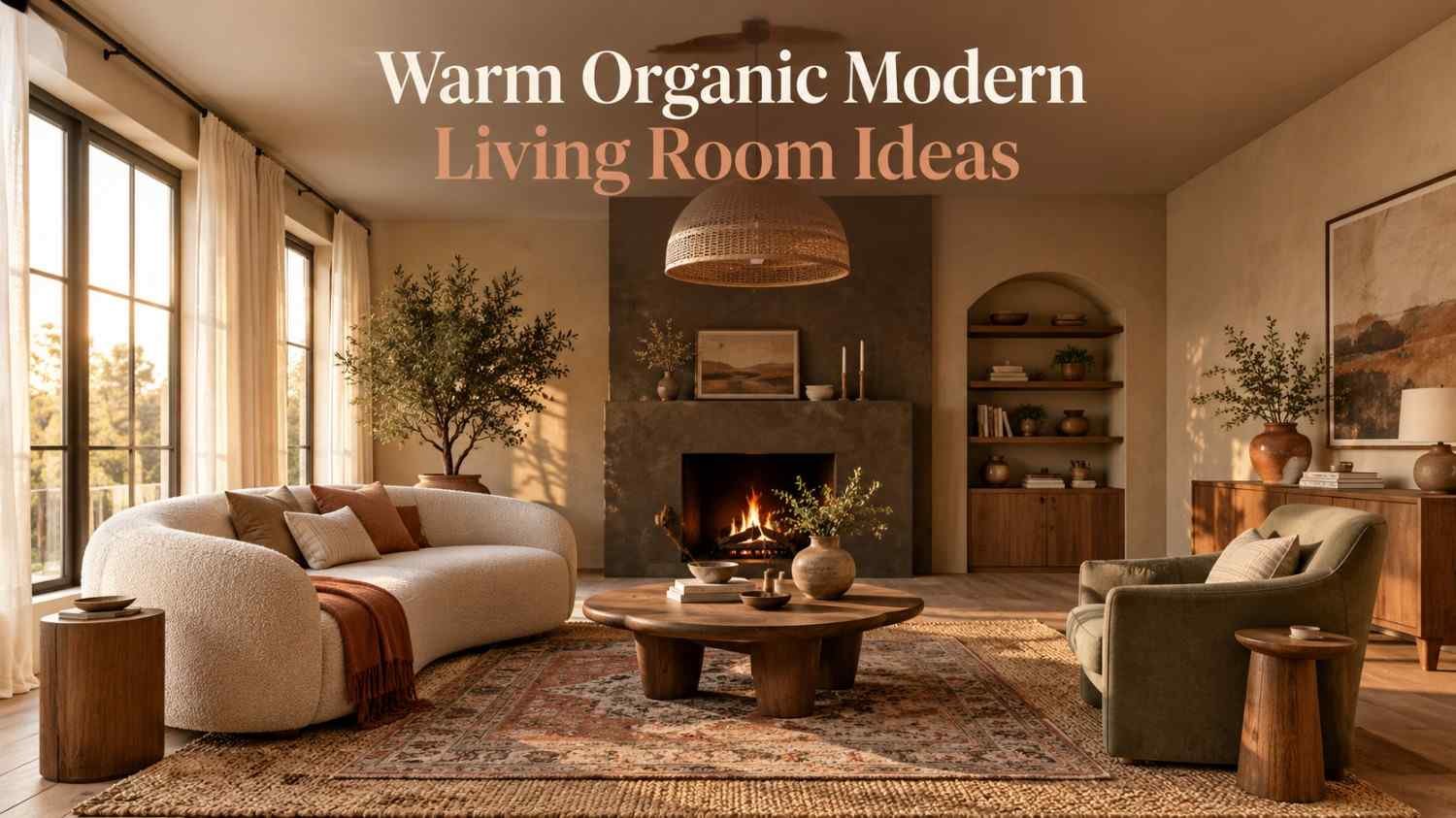
People chase a specific feeling when they save photo after photo of cream sofas and oak coffee tables. It is not minimalism. Minimalism can feel cold. It is the feeling of walking into a room where the light is soft, the wood has grain you can see, and nothing asks for your attention. That feeling has a name, and building it is more technical than most inspiration galleries admit.
A warm organic modern living room blends clean contemporary lines with natural materials, earthy color, and shapes borrowed from nature. Done well, it feels calm and lived-in at the same time. Done poorly, it turns into a beige waiting room.
The 25 ideas below are organized the way a designer actually works — palette first, then materials, furniture, textiles, and finishing touches. You will also find the numbers that matter: rug sizes, bulb temperatures, walkway clearances, and a phased budget so you do not buy everything at once.
What Actually Makes a Warm Organic Modern Living Room Work
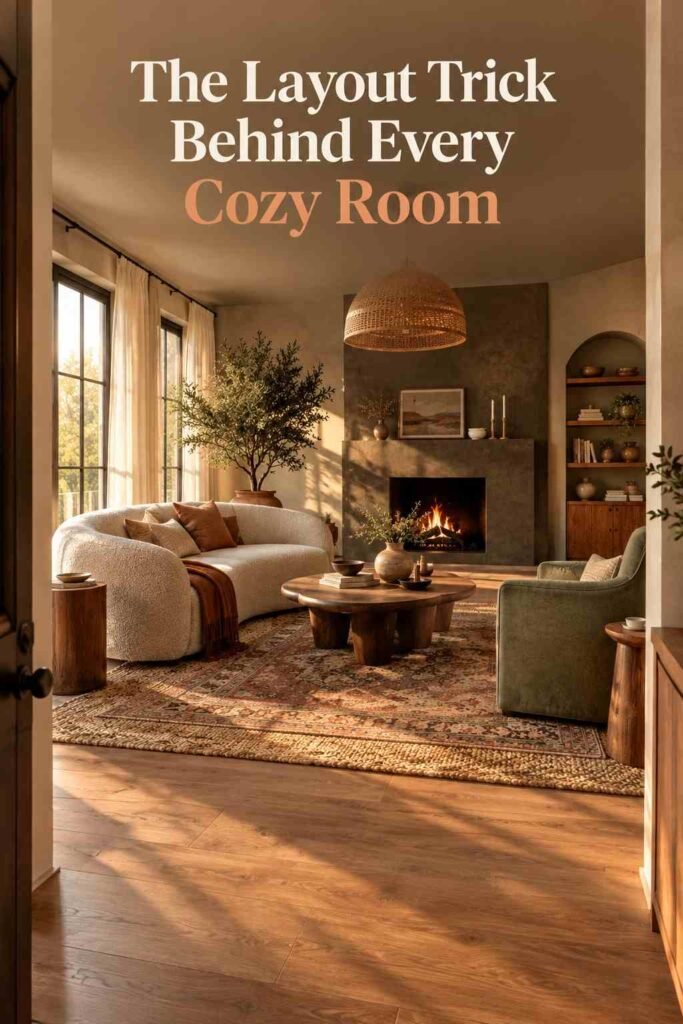
This style is older than the hashtag suggests. Frank Lloyd Wright argued for buildings in harmony with their landscape decades before the look reached mainstream retail. In 1940 and 1941, the Museum of Modern Art ran its Organic Design in Home Furnishings competition, where Charles Eames and Eero Saarinen won with molded plywood seating built around the human body rather than the right angle. That competition is the ancestor of every curved boucle chair sold today.
The modern version rests on three requirements. First, material honesty — wood that shows grain, stone with visible veining, fibers you can feel. Second, warm neutrals rather than cool ones, which is the difference between cozy and clinical. Third, restraint, meaning fewer objects doing more work.
Miss any one, and the room falls apart. Warm colors without texture look flat. Texture without restraint looks cluttered.
How It Differs From Japandi, Wabi-Sabi, and Coastal
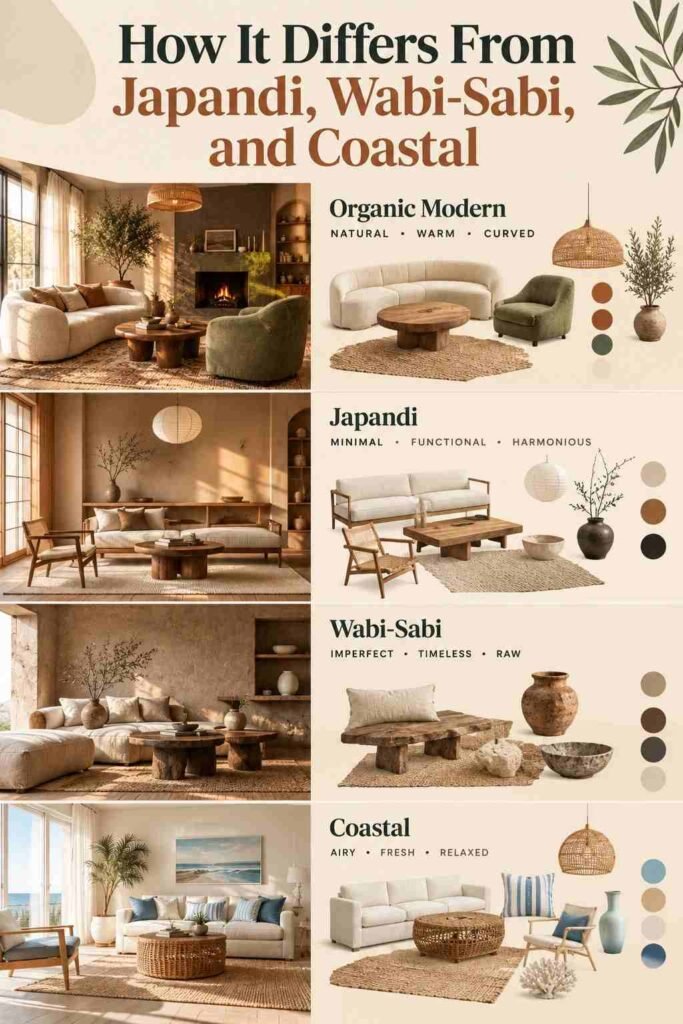
People confuse these constantly, and the confusion leads to shopping mistakes.
Japandi is cooler and more disciplined, leaning on black accents, low furniture, and near-empty surfaces. Wabi-sabi celebrates visible age and repair — cracked glaze, weathered timber, deliberate asymmetry. Coastal uses the same natural fibers but pulls the palette toward blue, white, and bleached wood.
Warm organic modern sits between them. It keeps the clean silhouettes of modern design, borrows the natural materials of all three, and pushes the color story toward sun-warmed tones: oatmeal, clay, caramel, mushroom, olive. The result reads relaxed rather than austere.
Build the Palette and the Light First
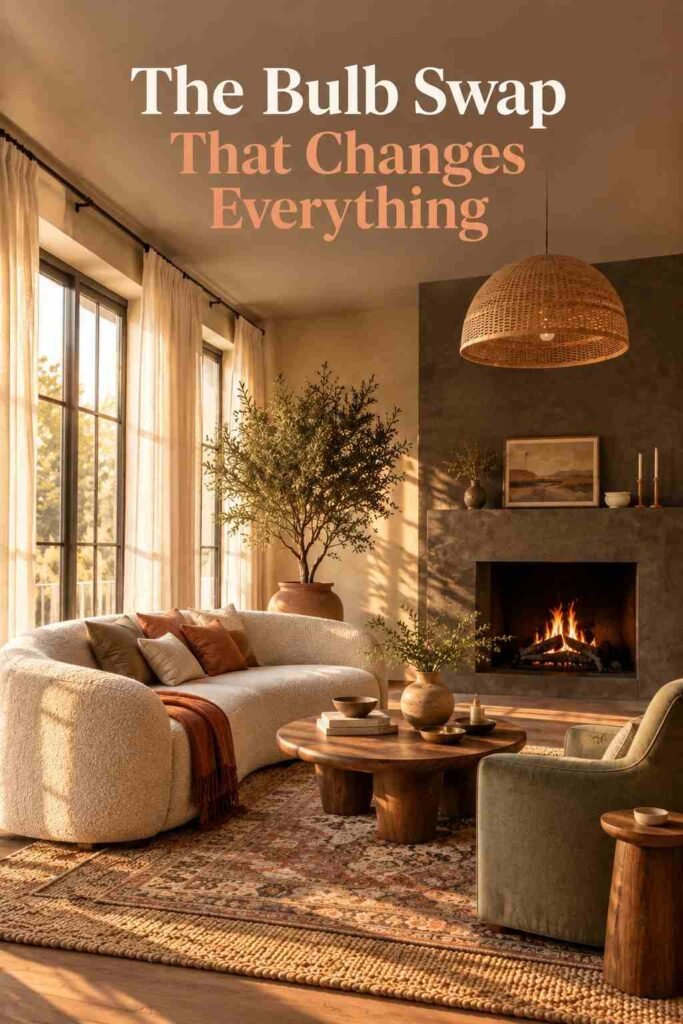
Color and light cost the least and change the most. Settle them before buying furniture.
1. Start with a warm off-white envelope. Choose a white with a yellow, pink, or greige undertone rather than a blue-based one. Paint a large sample board, then look at it at 9 a.m. and again at 7 p.m. Cool whites go grey at dusk and drain the warmth out of everything nearby.
2. Give the room one deeper earth tone. A single grounding color — clay, olive, mushroom, or tobacco — keeps neutrals from blurring together. Apply it to roughly ten percent of the room: a pair of chairs, the drapery, or a built-in bookcase back.
3. Paint trim and walls the same shade
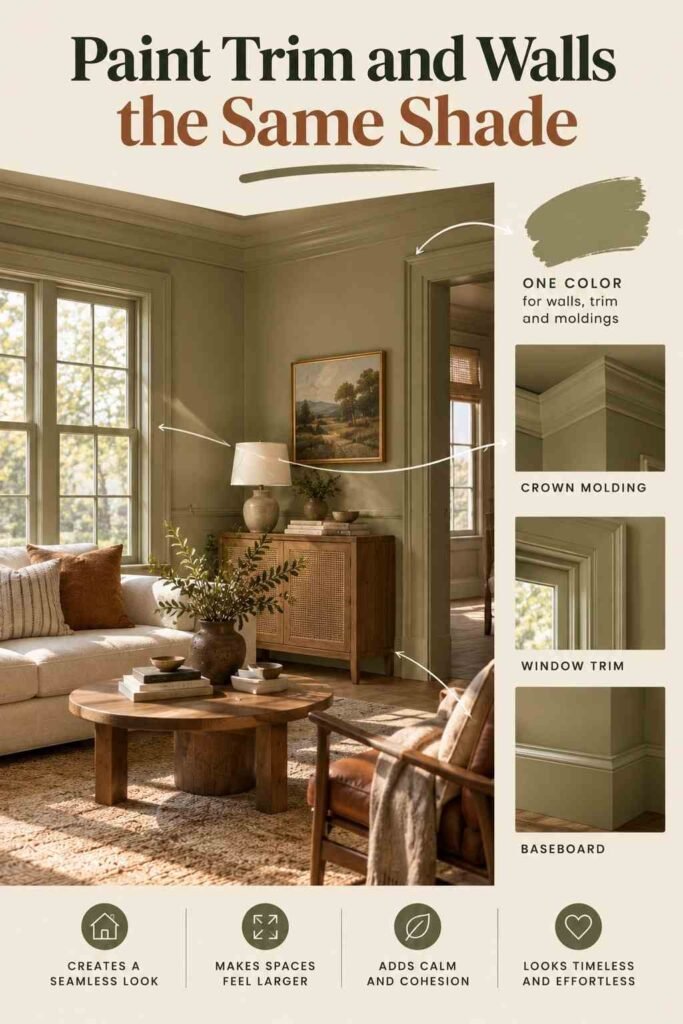
Removing the white-trim contrast line makes the room feel like a continuous envelope rather than a series of framed edges. It is a one-weekend change with an outsized calming effect.
4. Build light in three layers. Every seating zone needs ambient light overhead, task light at reading height, and a low accent light such as a table lamp. Three modest sources beat one bright ceiling fixture in every case.
5. Switch every bulb to 2700K and add dimmers. Bulb color temperature is the single most overlooked variable in a warm organic modern living room. Anything at 4000K or above turns caramel leather grey and makes oak look orange.
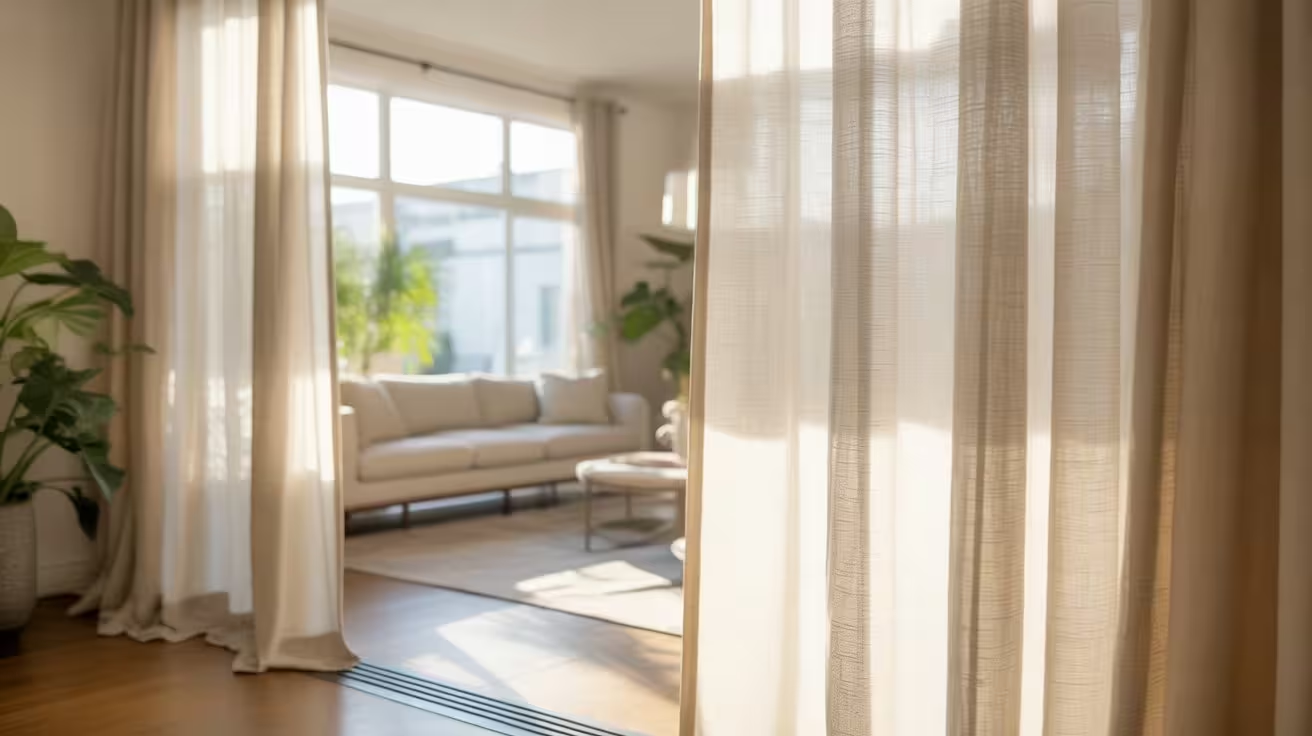
6. Hang drapery high and wide. Mount the rod four to six inches below the ceiling and extend it eight to twelve inches past each side of the window. Unlined linen or cotton filters daylight into something softer without blocking it.
Choose Materials That Age Well
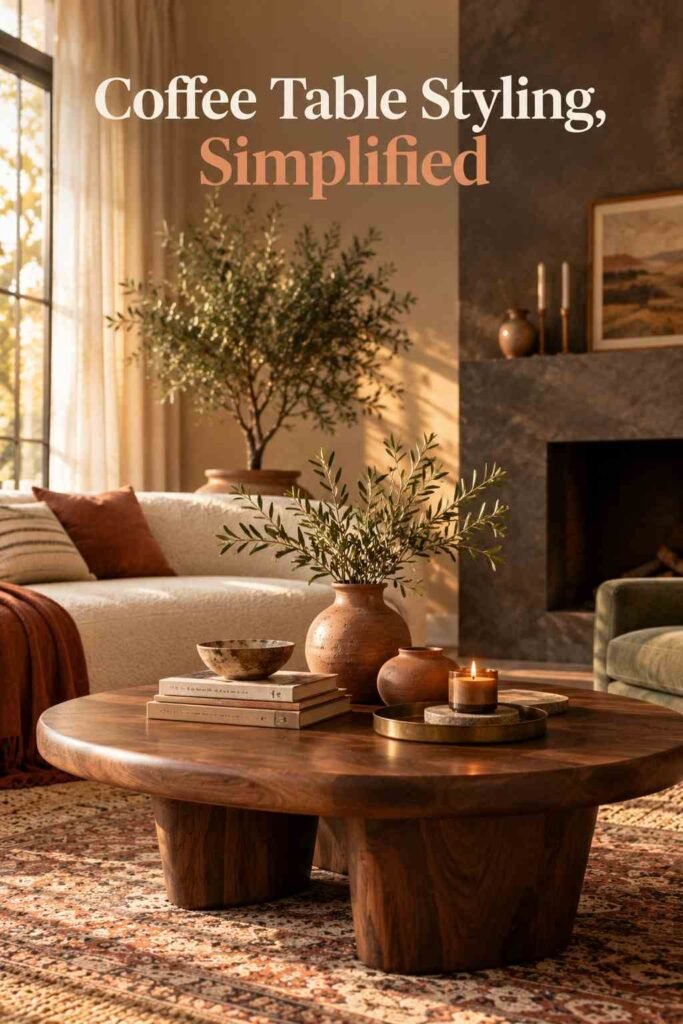
Materials are where this style earns its warmth. Choose things that improve with use.
7. Pick one primary wood and one contrast wood. Matching furniture sets read as showroom displays. Let one tone dominate roughly sixty percent of the wood in the room — white oak, for instance — then introduce walnut or reclaimed pine as the contrast. Shared undertone matters more than identical color.
8. Bring in real stone. A travertine side table, a limestone hearth, or a soapstone tray adds geological texture no laminate reproduces. Stone also provides visual weight, which prevents a soft, upholstered room from feeling like it might float away.
9. Treat one wall with limewash or plaster. Mineral finishes shift subtly across the day as light moves, giving a plain wall depth without pattern. It is the cheapest way to add texture to a room short on architectural detail.
10. Add a woven element overhead
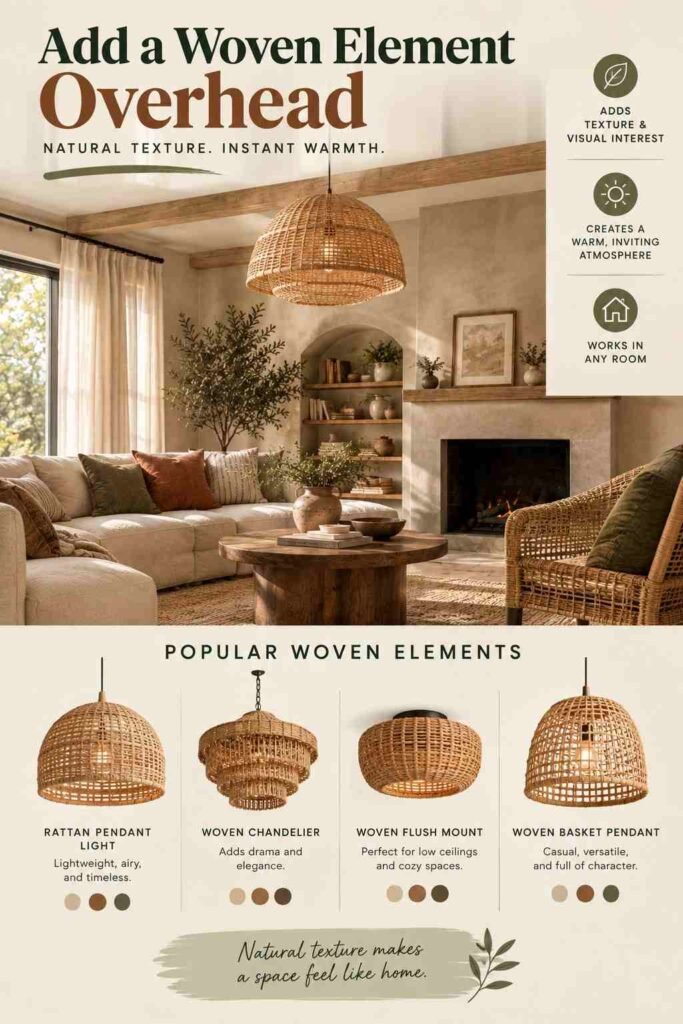
A rattan, paper, or raffia pendant casts patterned shadow and pulls the eye upward. Overhead texture is consistently missing from rooms that otherwise get everything right.
11. Use unglazed ceramics and terracotta. Matte, porous surfaces absorb light where glass and chrome bounce it. A few raw clay vessels do more for warmth than a shelf of polished decorative objects.
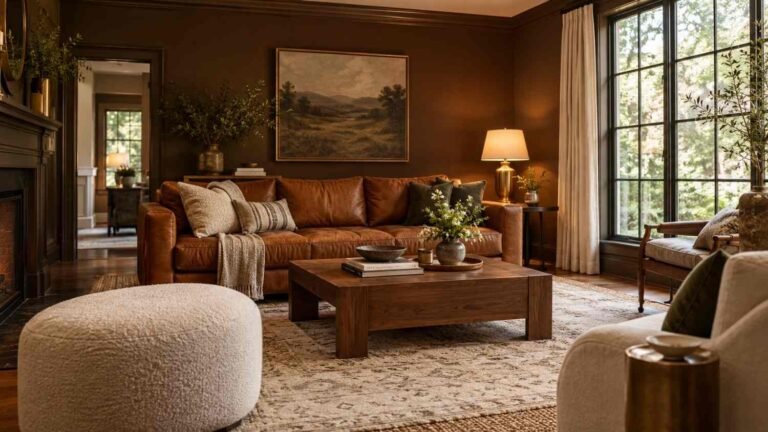
12. Choose leather that develops patina. Full-grain leather in cognac, tobacco, or saddle softens and darkens with use rather than cracking. A single leather piece among linen and wool provides necessary contrast in sheen and firmness.
Get Furniture Shape, Scale, and Layout Right
Layout failures are the most expensive mistakes because they require returns.
13. Anchor with a low-profile sofa. Look for rounded arms, a relaxed back, and a seat depth of 38 to 42 inches for genuine lounging. Slipcovered linen and performance weaves both suit a warm organic modern living room; the second survives children and pets considerably better.
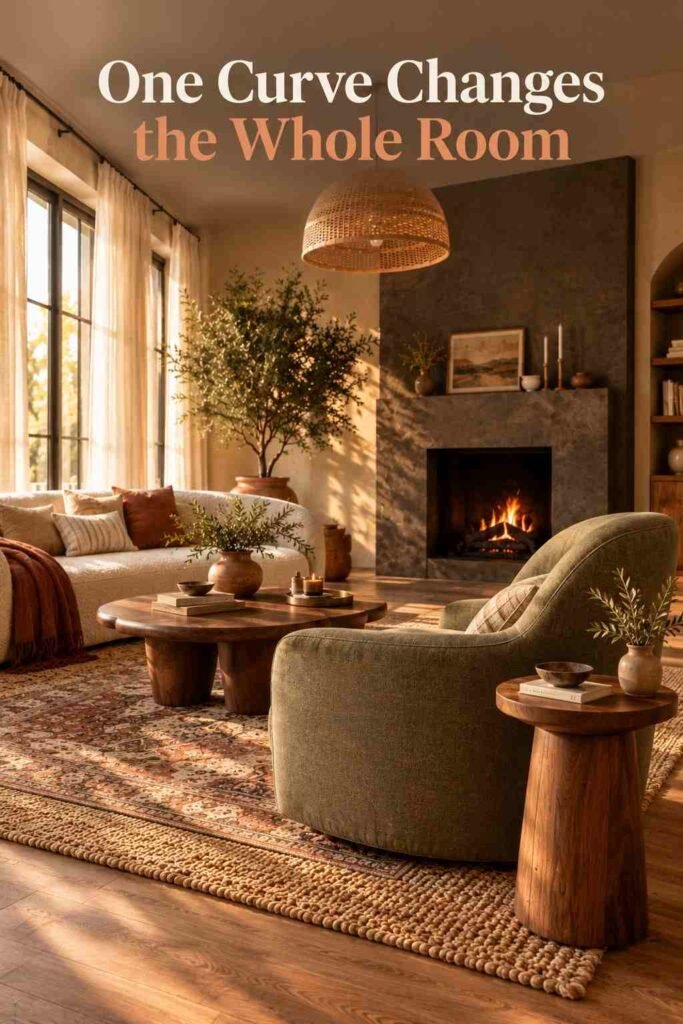
14. Add one sculptural curve as counterpoint. A kidney bench, an arched floor lamp, or a rounded accent chair breaks the grid of a rectangular room. One strong curve is memorable. Four compete with each other and read as a gimmick.
15. Float the furniture off the walls
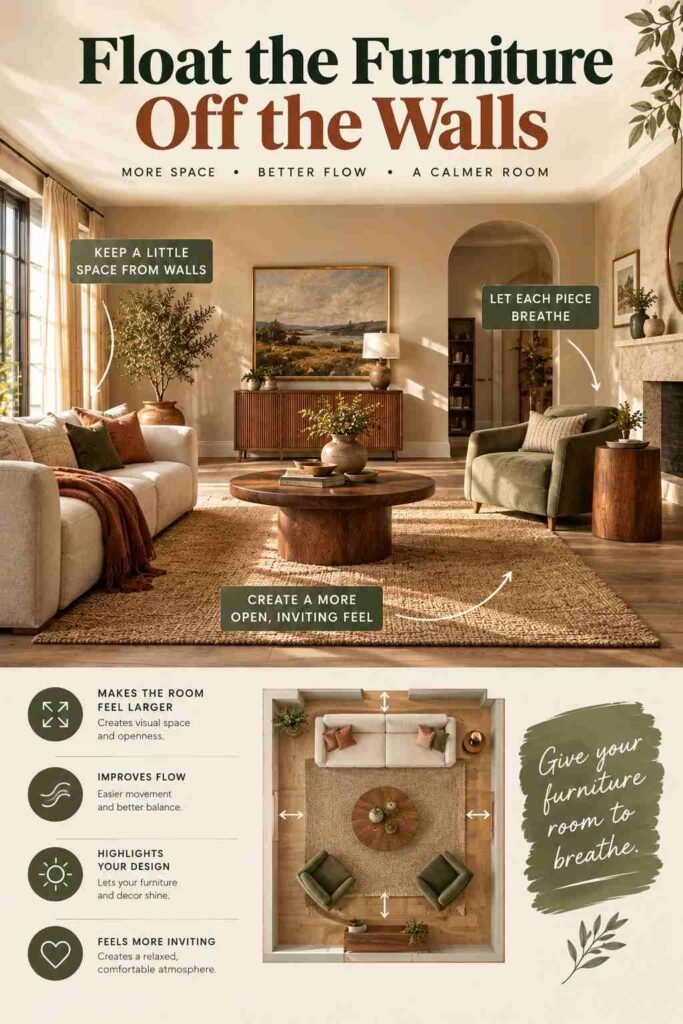
Pushing everything to the perimeter creates a dead zone in the middle. Pull the sofa forward even six inches and keep primary walkways at 30 to 36 inches wide.
16. Size the rug generously. At minimum, the front legs of every seating piece should sit on it, with the rug extending past the sofa’s width on both sides. Most living rooms need 8×10 or 9×12 feet. A small rug adrift in the center makes the whole room look underfurnished.
17. Vary the heights deliberately. Pair a low coffee table with a mid-height console and one tall element — a floor lamp, a tree, a leaning mirror. Flat height creates a horizontal band that reads as monotonous.
18. Include at least one vintage or secondhand piece. An old spindle chair, a worn trunk, or an inherited stool introduces age that no new purchase can fake. It is also usually the cheapest character in the room.
Layer Texture and Textiles
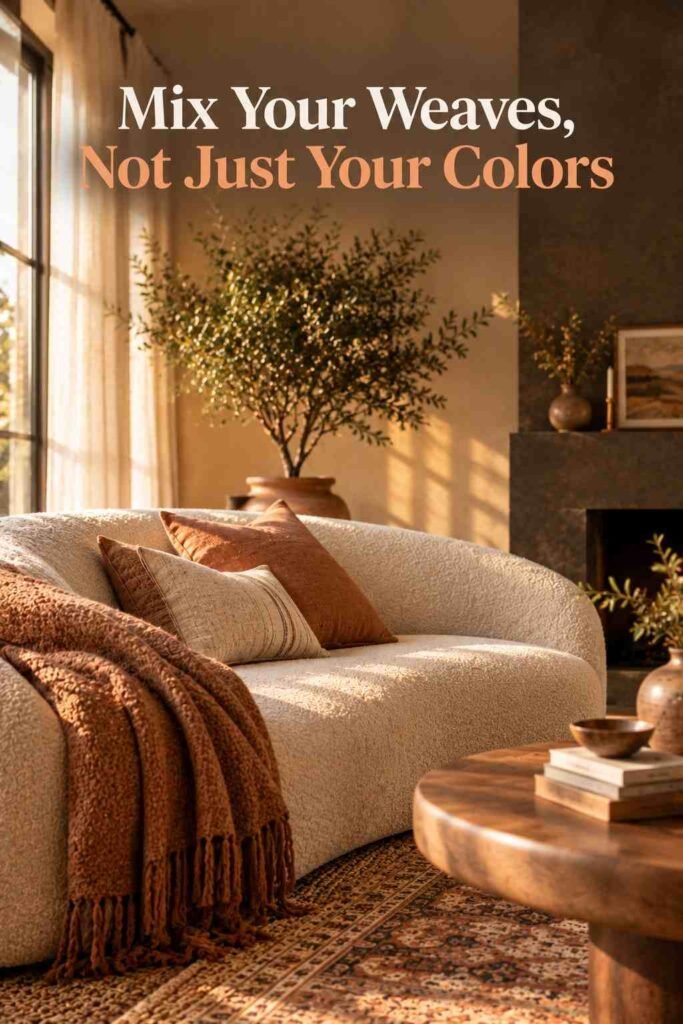
19. Layer a small patterned rug over a large natural one. Place a wool or vintage Moroccan rug over a jute or sisal base. You get the handmade character without paying room-size prices, and the jute handles traffic underneath.
20. Mix weave weights, not just fabrics. Fine linen drapery, a chunky wool throw, a tight boucle chair, and a loose cotton slipcover create contrast your hand registers before your eye does. That tactile variety is what separates a warm organic modern living room from a flat one.
21. Use odd numbers and varied pillow sizes. Combine 22-inch, 20-inch, and lumbar pillows rather than four matching squares. Down or down-alternative inserts slouch; foam inserts stay rigid and look untouched.
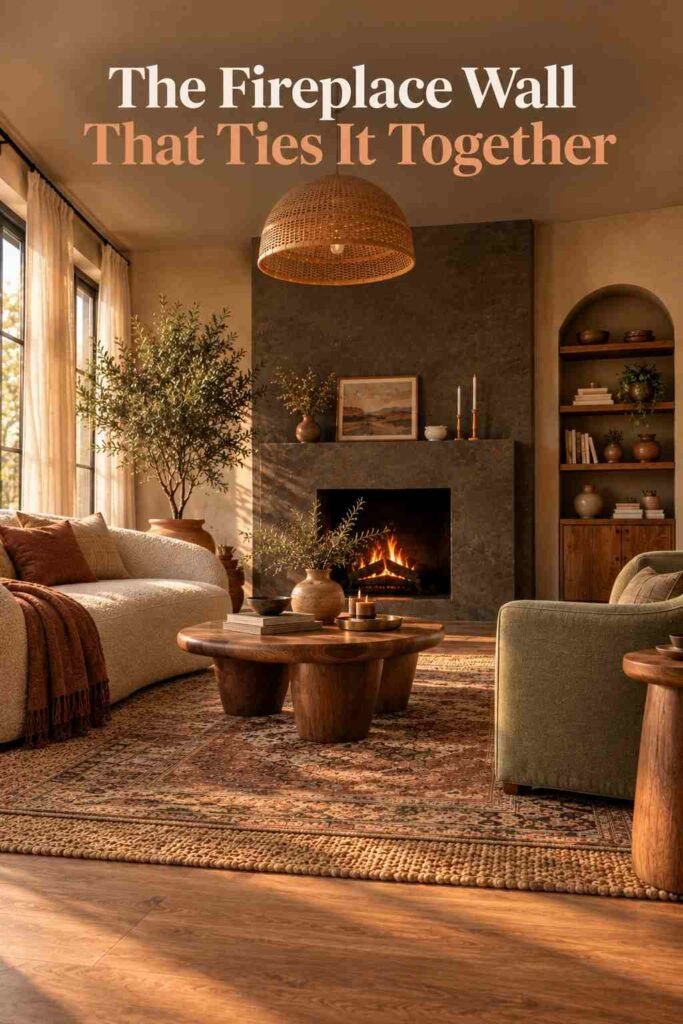
22. Give the room a warm focal point. A plastered fireplace surround, a wood-clad media wall, or a broad arched niche gives the eye somewhere to land. Without a focal anchor, even a well-furnished room feels unresolved.
Finish With Greenery and Personal Objects
23. Choose plants for your actual light, not the photo. Olive trees and fiddle-leaf figs demand several hours of bright direct sun. In a north-facing room, a snake plant, ZZ plant, or cast-iron plant will survive where the aspirational tree slowly declines.
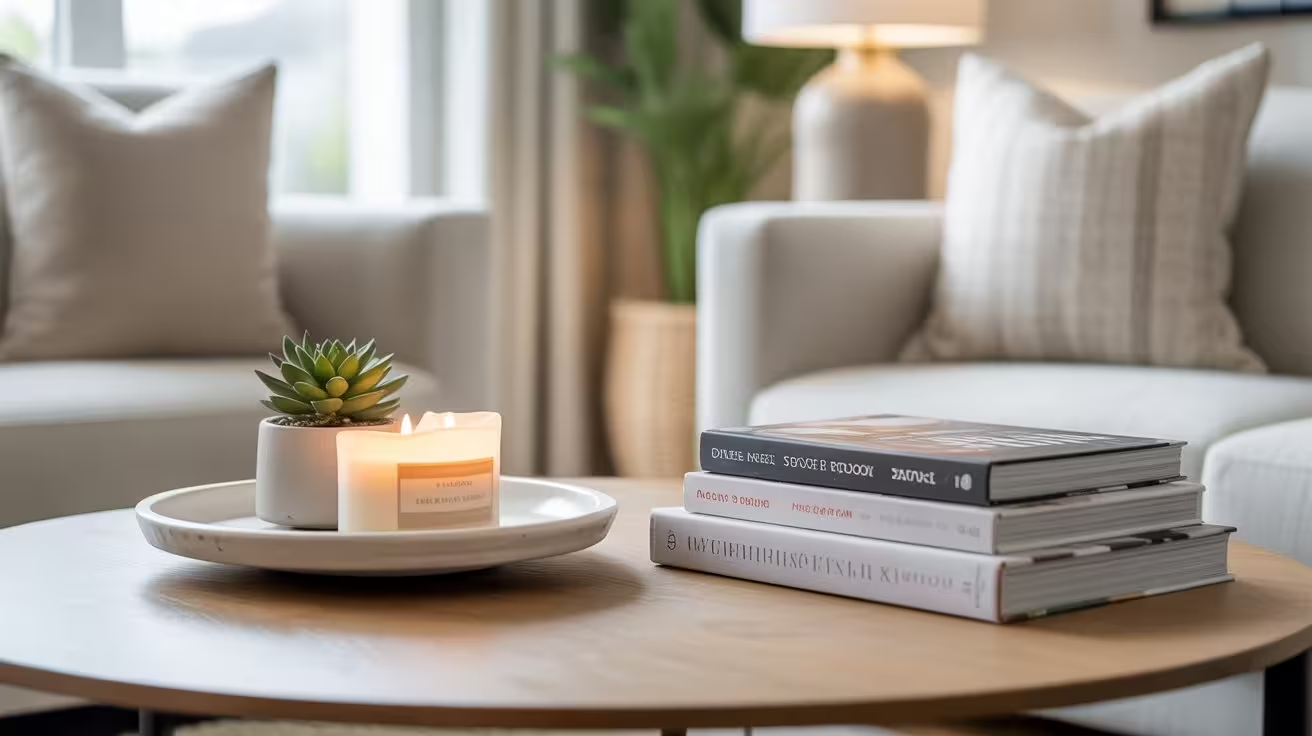
24. Curate fewer, larger objects. Three substantial pieces on a console beat twelve small ones. Over-styled shelves are the most common failure in this style — the visual noise cancels the calm the palette worked to create.
25. Protect the space. Leave at least one surface deliberately bare and one corner unfilled. Negative space is an active design element here, not an unfinished to-do item. If you prefer richer detailing and deeper color, a Victorian living room takes the same emphasis on craftsmanship in a far more ornamental direction.
Five Mistakes That Flatten the Look
- Neutral-on-neutral monotony. Cream walls, cream sofa, cream rug, no contrast. The fix is not more color — it is more texture and one darker anchor.
- Cool-toned lighting. Beautiful materials under 5000K bulbs look grey and lifeless. Check every bulb.
- Matching wood sets. Buying a coffee table, console, and side table in one finish removes the collected-over-time quality the style depends on.
- Faux materials in high-touch places. Printed woodgrain and plastic “rattan” fail exactly where hands land. Spend on what you touch daily.
- Buying accessories before furniture. Small purchases accumulate fast and rarely fix a layout problem.
A Phased Budget Plan That Actually Works
Building a room in one weekend is how people end up with flimsy pieces they replace within two years. Phase it instead.
- Phase one costs the least: paint, warm bulbs, dimmers, and rehung drapery. This alone transforms the atmosphere.
- Phase two buys the rug and the sofa — the two items that dictate everything else. Buy these well, even if it means waiting.
- Phase three adds the wood anchor: a console, coffee table, or shelving that brings grain into the room.
- Phase four layers textiles, lighting, ceramics, and plants. By this stage, you are decorating a room that already works rather than compensating for one that does not.
Adapting the Style for Small Rooms and Rentals
Small rooms benefit from this palette because warm neutrals recede. Keep furniture legs visible so the floor reads continuously, choose a round coffee table to ease circulation, and hang one large mirror opposite the main light source rather than several small ones. At Outinteriors tests these material and layout principles across real homes before recommending them.
Renters can get most of the effect without touching walls. A peel-and-stick limewash panel, a large natural-fiber rug, linen drapery on a tension-mounted rod, and two warm-toned lamps deliver roughly eighty percent of a warm organic modern living room with nothing permanent. Change what sits underfoot, beside the sofa, and at the windows first.
Keeping Natural Materials Looking Good
Unfinished and oiled wood needs re-oiling once or twice a year. Jute sheds initially and dislikes moisture, so keep it out of entry paths and damp rooms. Linen wrinkles by nature — that is the look, not a defect. Full-grain leather wants conditioning every six to twelve months and should sit away from direct sun and radiators. Rotate seat cushions monthly so wear spreads evenly. For anyone who wants a single statement seat with real presence, a Chesterfield sofa living room layout proves that tufted leather sits comfortably alongside natural textures.
Final Thoughts
The rooms that succeed in this style share one quality: they were built in the right order. Light and color first, then materials, then furniture, then the soft layers, then the few personal objects that make the space yours.
Start with the two changes that cost almost nothing — swap your bulbs to 2700K and add dimmers — and see how much warmer the room already feels. Everything after that is layering. A warm organic modern living room is meant to be lived in, softened, and slowly filled with things you actually love, not finished in a single afternoon.
Frequently Asked Questions
What colors work best in an organic modern space?
Warm neutrals form the base: oatmeal, greige, warm white, sand, and putty. Add depth with clay, terracotta, olive, mushroom, or tobacco. Avoid blue-based greys and stark whites, which pull the room cool and undo the natural materials.
Can I get this look on a small budget?
Yes. Paint, warm bulbs, and rehung drapery are inexpensive and change the room most. Secondhand wood furniture, thrifted ceramics, natural-fiber rugs, and real plants fill in the rest. The style rewards patience far more than spending.
What is the difference between organic modern and modern farmhouse?
Modern farmhouse relies on shiplap, black metal, and cottage-style detailing. Organic modern uses sleeker silhouettes, mineral finishes like plaster and limewash, and curved forms rather than rustic references.
Which plants suit this style?
Olive trees, fiddle-leaf figs, rubber plants, and birds of paradise for bright rooms. Snake plants, ZZ plants, and pothos for low light. Match the plant to the room’s real light, or it will struggle.
Does it work in a home with kids and pets?
It does, better than most styles. Performance linen and washable slipcovers, wool rugs that hide crumbs, and rounded furniture edges all suit family life. Wood and leather that patina age more gracefully than lacquer under daily wear.
How many textures should a room have?
Aim for four to six distinct ones — wood, stone, a woven fiber, linen, wool, and leather is a reliable combination. Fewer reads flat; significantly more starts to feel busy.
Do I need an accent wall?
No. A single limewashed or plastered wall adds depth, but a warm focal point such as a fireplace surround or wood-clad media wall achieves the same result without committing to a bold color.